Eielson Air Force Base, Alaska – The Air Force's premier training exercise for its crews in the Pacific had met its match, at least temporarily.
Hundreds of airmen, along with troops from other services and South Korea, made their way here for Red Flag Alaska 15-1. The crews were on scene for two weeks of high-level training. But for the first time in three years, weather got in the way.
Several inches of snow and temperatures of 20 degrees stopped aircraft from taking off. Dozens of U.S. and international aircraft would have to wait for the go ahead to begin their training.
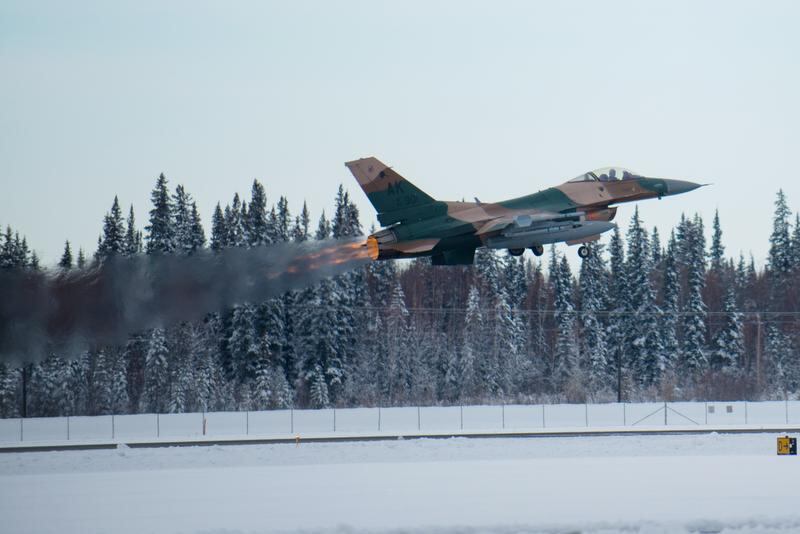
Once the runways were cleared and the crews were ready, dozens of fighters launched into the Alaska sky from the Eielson runway, headed toward the massive Joint Pacific Alaska Range Complex where they would "play."
"We use exercises like Red Flag to allow us to train together; learn the nuances in each other's languages; merge our tactics, techniques and procedures; and experience the flavor of tactics that each service or nation brings to the fight so we can learn from each other, better integrate with each other and eventually better fight alongside each other," said Lt. Col. A.J. Pelkington, the deputy deployed forces commander for Red Flag and 8th Operations Support Squadron commander at Kunsan Air Force Base, South Korea.
Coming back after sequester
The Air Force places a lot of emphasis on its Red Flag exercises, with Air Force Chief of Staff Gen. Mark Welsh saying the service cannot again cancel the exercises like it was forced to do in 2013 because of sequestration.
"Red Flag is integral to [training]. It's what creates our PhD-level war fighters for the Air Force. The weapons school creates our actual PhDs, who then train the rest of the force," Welsh said after Congress passed short-term budget relief after sequestration in 2013.
Units in Pacific Air Forces use the opportunity to try to maximize "every dollar" they can and attempt to regain some of the training that was lost in the standdown and cancellations of 2013, Pelkington said.
"Red Flag-Alaska is the most important training event that our units will do this entire fiscal year," Pelkington said. "In terms of the level of exposure to the other services, to the integration with the partners and allies, to the range here — a flying capability that we don't have.
"It's extremely important that we continue to cycle our pilots through these types of events. We don't get a lot of time here, but we make sure we make good use of every minute that those dollars buy."
Red Flag traces its roots to the dog-fighting days of the wars in Korea and Vietnam. Studies showed that the chances of a pilot surviving a war greatly increased after the first 10 combat sorties. The Air Force decided to create the exercise as a way to effectively fly a pilot's first 10 combat sorties in a training environment.
Red Flag began in 1975 at Nellis Air Force Base, Nevada. Pacific Air Forces began a similar training program in 1976 called Exercise Cope Thunder, which began Red Flag-Alaska in 2006. Now Eielson is host to four of the exercises per year, with each featuring dozens of aircraft flying hundreds of sorties in Alaska.
Red Flag Alaska 15-1 kicked off operations on Oct. 6, with a bit of a hitch in the form of about four inches of snow and temperatures lingering at about 20 degrees, forcing crews to cancel the first scenario.
This iteration of Red Flag includes F-16s from the 18th Aggressor Squadron at Eielson, F-16s from the 35th Fighter Squadron at Kunsan; KF-16Ds from the Republic of Korea Air Force; KC-135s from the 168th Air Refueling Squadron at Eielson; Marine Corps AV-8Bs from VMA-311 at Marine Corps Air Station Yuma; E/A-18Gs from VAQ-133 at Naval Air Station Whidbey Island; joint terminal attack controllers from the 3rd Air Support Operations Squadron at Joint Base Elmendorf-Richardson, Alaska; and HH-60Gs from the 210th Rescue Squadron at Elmendorf.
Elmendorf is also hosting E-3 Sentrys from the 962nd Airborne Air Control Squadron from that base and the 961st AACS from Kadena Air Base, Japan; C-17s from Elmendorf; C-130Js from the 41st Airlift Squadron at Little Rock Air Force Base, Arkansas; C-130Hs from the Republic of Korea Air Force; MC-130Ns from the 211th Rescue Squadron at Elmendorf; and C-130Hs from the 700th Airlift Squadron at Dobbins Air Reserve Base, Georgia.
Growing pilot confidence
The exercise features two rounds of flights per day for 10 days, with each different. Some missions focus on air-to-air combat, others on air interdiction or the suppression of enemy defenses. They all begin with a briefing, where a commander — which rotates from each involved unit — plans how the pilots will attack the mission and fight against the designated enemy, Eielson's 18th Aggressor Squadron.
"You get out there, and every flight's different with how the red air responds to the blue force's tactics," Pelkington said. "It's never the same flight, there's always something slightly different. ... You have to be flexible enough to take the lessons learned in previous [flights]."
Air crews on the first day can resemble a youth soccer team, Pelkington said. Everyone is technically on the same team, but trying to do their own thing.
But as the flights continue and as pilots get familiar with each other, "Naturally your skills get better, your situational awareness envelope expands," Pelkington said. "You're able to learn to process more of the components that are moving in a mission set as opposed to just your one piece."
Early on, the aggressors take control. But the blue force begins to learn and work together so that, even as the missions become more difficult, the friendly forces can take over. The more inexperienced pilots in the training start with a level of anxiety, but as the flights continue, the pilots gain more confidence and become more capable in the mission.
"You're going to see them become significantly more comfortable in doing this over the course of two weeks," Pelkington said. "If we can make that significant change in just two weeks, that person who deploys to that[area of responsibility] with that experience level is better off and significantly more prepared."
Maintaining the forces
The host for each Red Flag-Alaska is a unique unit in the service, the 18th Aggressor Squadron. The squadron's logo, on everything from protective covers on their F-16s to parking lot signs, evokes Soviet imagery consistent with its mission of being the "red force," or bad guys, in the training mission. The squadron's Block 30 F-16s are painted in unique livery, designed to mimic MiGs or other potential adversary fighters.
"Our whole purpose of Red Flag is to provide safe aircraft for pilots to pretend to be the bad guys, or red air, to help our Air Force fight," said senior airman Michelle Park, a crew chief with the 18th Aircraft Maintenance Unit.
The largest "blue force" in the most recent Red Flag was made up of 12 F-16s of the 35th Fighter Squadron at Kunsan Air Base, South Korea. About 100 airmen made the trip to fly and maintain the F-16s at Eielson for the two-week exercise.
The airmen working on the aircraft treat the experience like a deployment, and they are preparing to tackle issues they would face if they were out getting the aircraft ready for a real war.
"This would be considered like deployed maintenance for our career field," said Senior Airman Robert Schwalb, aircraft structural maintenance technician with the 8th Maintenance Squadron. "We don't have all our items available on hand. We bring the bare minimum and prepare for a scenario as if we did deploy."
The Kunsan group planned to fly 10 aircraft in the first exercise every morning, with a short break after landing, then another eight flying in the afternoon. This gives the maintainers a limited window to check on their aircraft and address any issues.
A ballet
Up to 80 aircraft take off and land closely together during the exercise. The job of keeping Red Flag running smoothly and safely falls to airfield operations staff with the 354th Airfield Operations Squadron. A staff of about five keeps an eye on the airfield, and coordinates with the nearby Fairbanks airport and an air traffic control center in Anchorage to jet the aircraft from Eielson and to the range.
"It's a big, well-choreographed ballet," said Capt. Eric Thomas, the airfield operations flight commander.
Young enlisted airmen direct from the tower.
"We've got airmen out of high school working the heck out of this job," Thomas said. "When things go bad, they get recognized. When things go good, no one knows."
On the flightline, weapons loaders build and load weapons they would use on deployments — and pilots are able to drop live bombs from the large Joint Pacific Alaskan Range.
"Because of the airspace and the military range we have here, they get to drop things here that they don't get to drop in other parts of the country," said Tech. Sgt. James Jerrell, the assistant noncommissioned officer in charge of conventional weapons maintenance with the 354th Aircraft Maintenance Squadron. "They'll get to handle things here that they may never get to handle at other bases. Live missiles, live bombs."
On a recent morning, bomb crews at Eielson were readying Mark 82 500-pound bombs that F-16D pilots from South Korea were going to drop on the range.
"For the F-16 pilots, they'll come here and get to drop a live missile for the first time in their career," Jerrell said.
Operations among the bomb builders go at a "pretty high speed," even if the crews are unfamiliar and there is still a language barrier, said Senior Airman Skyler Chupp, a conventional weapons maintenance crew chief.
"We make sure to the best of our ability that they follow our rules," Chupp said. "We can't afford to have a linguist out there at all times. It's difficult to get past that. They're all very smart, obviously, but the language thing is big. Also the way they've been trained is also obviously a lot different. They're smart, they catch on quick."
This experience gained directly translates to what is needed when deployed.
"When the time comes to go over to the AOR we have that experience and that knowledge," said Chief Master Sgt. Joseph Kitchel, the munitions flight chief with the squadron. "So when it's real, when it's going out to kill a bad guy, we have the experience and the knowledge to do that quickly and correctly."
On the ground
Red Flag is known for its air-to-air combat exercises, but the bombing practice provides practice for joint terminal attack controllers on the ground, too.
Ten JTACs with the 3rd Air Support Operations Squadron out of Elmendorf came to Red Flag to work with the pilots on training scenarios that are meant to simulate future conflicts.
"We're looking for what we can expect for our future war, for a major combat operation," said Staff Sgt. Dustin Stelljes, a JTAC with the 3rd ASOS. "It's a large force-on-force, with tanks against tanks. Enemy threats and our aircraft, the large scale you would expect from China or Korea. That's what we're preparing for and making sure everyone is on the same page."
The other services
Red Flag 15-1 gave a Navy unit its first chance for joint training in one of its newest jets. Three EA-18G Growlers from VAQ-133 Naval Air Station Whidbey Island, Washington, flew to Eielson for the first Air Force-hosted exercise since they began flying the new electronic attack aircraft three months ago.
"We hadn't gotten much experience in the jet," said Lt. Lawrence Stoulig, a Growler pilot with VAQ-133. "It's a good chance to come up here and see a large force exercise firsthand."
The Navy jets participated in almost all the training scenarios, helping blue forces locate and target potential threats.
"Our electronic role is to find, detect and locate enemy radars, enemy surface to air missiles," Stoulig said. "We have the capabilities in this platform to do that very well."
VMA-311 from Marine Corps Air Station Yuma, Arizona, also made the trip to Alaska with their AV-8B Harriers. The squadron recently reunited after being split into three groups and sent to Okinawa, Japan, the West Coast and Afghanistan, Sgt Maj. David Wilson said.
"Those [detachments] came back from the deployment together, and assimilate back," he said. "That's the other benefit of exercises like this: It's certainly good for cohesion and team building."
Lance Cpl. Katelynn Skalnik, an avionic electrician with the squadron said she enjoys seeing how members of all the services work together. "It's a learning experience, and that's what I like about this whole Red Flag operation."