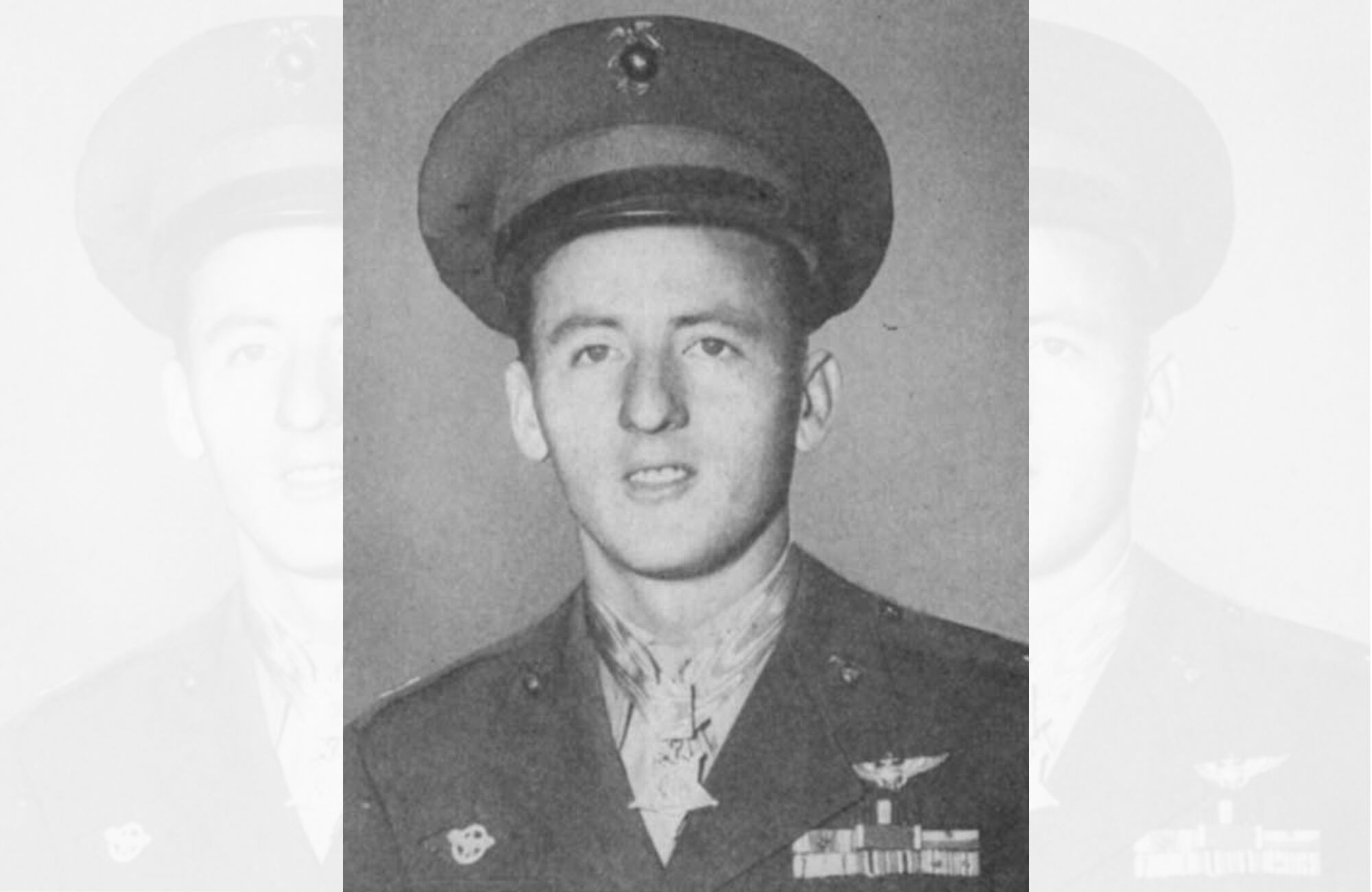
Behind his Louisiana Cajun drawl, Jefferson Joseph DeBlanc harbored the intellect of an academic with the physique of a star athlete. Born on Feb. 15, 1921, in Lockport, Louisiana, he graduated from high school in 1938, but cut college short to try his hand at military aviation. He allegedly claimed that as a loyal Southerner he could not abide joining “the Yankee army,” so he enlisted in the U.S. Marines instead.
DeBlanc entered U.S. Navy flight training in July 1941, then transferred to the Marine Corps upon completion. Commissioned a second lieutenant on April 3, 1942, and rated a naval aviator on May 4, he joined Marine fighter squadron VMF-112 10 days before it shipped overseas — just long enough to get a few flying hours in the Grumman F4F-4 Wildcat.
Arriving at Henderson Field on Guadalcanal, DeBlanc did not get his first crack at the enemy until Nov. 12, when elements of VMF-112 and Capt. Joseph J. Foss’s flight of VMF-121 found themselves above an onslaught of Mitsubishi G4M1 twin-engine bombers attacking American shipping.
It was, he later recalled, “a fighter pilot’s dream,” or would have been had it not been for the antiaircraft fire thrown up by the ships. Two Wildcats were brought down by that flak, the Japanese or both, but both of their pilots survived.
DeBlanc closed to near-collision range with his first target, which splashed in the sea, and quickly followed that with a second bomber and a possible third that was not confirmed.
He would not get another chance at the enemy until Dec. 18, when he came upon a Douglas SBD-3 Dauntless dive bomber pursued by an aggressively flown Mitsubishi F1M2 two-seat biplane. As he attacked, the floatplane exploded.
Promoted to first lieutenant, DeBlanc suffered a temporary setback on Jan. 29, 1943, when his Wildcat suffered engine trouble and he had to take to his parachute. He was swiftly picked up by the destroyer Jenkins (DD-447), but this proved only the prelude for the busy day he was about to have.
On Jan. 31, DeBlanc was flying his Wildcat at the head of eight others and engaging enemy fighters when he learned of 12 Grumman TBF-1 Avengers and SBDs attacking enemy shipping near Kolombangara.
Leading his pilots south, he came upon the bombers beset by ferociously manned Mitsubishi F1Ms. Coming down along the topside, DeBlanc shot down one bomber’s pursuer, then surprised another from below and behind, sending that floatplane down as well.
At that point, DeBlanc heard someone radio “Zeros!” Fuel was running low and the enemy had the altitude, but resigning himself to a long swim home, DeBlanc joined with Staff Sgt. James A. Feliton of VMF-121 to employ mutually supporting Thach weave tactics against their opponents.
DeBlanc shot down two of the fighters, but Feliton was hit in the engine. Then, after downing his fifth victim of the day, DeBlanc was wounded and set afire by yet another adversary and had to bail out. Both he and Feliton parachuted into Vella Gulf, swam to Kolombangara and were rescued by native coastwatchers, who subsequently hid them, reported their status to Solomons Air Command and arranged their return to Guadalcanal on Feb. 12.
Unknown to DeBlanc and Feliton, the “Zeros” they’d fought were actually Nakajima Ki.43 army fighters, which had just been assigned to Rabaul while the navy’s Zero units were withdrawn to replace their losses over the past half year.
Both Marines were apparently credited to Sgt. Takeo Takahashi, whose eventual wartime score totaled 13 when he was shot down and killed in a transport plane over Manila Bay, Philippines, on Nov. 13, 1944.
The flying boat that picked up DeBlanc was escorted by the first Vought F4U-1 Corsair mission, one of which was flown by future Medal of Honor recipient Lt. Kenneth A. Walsh.
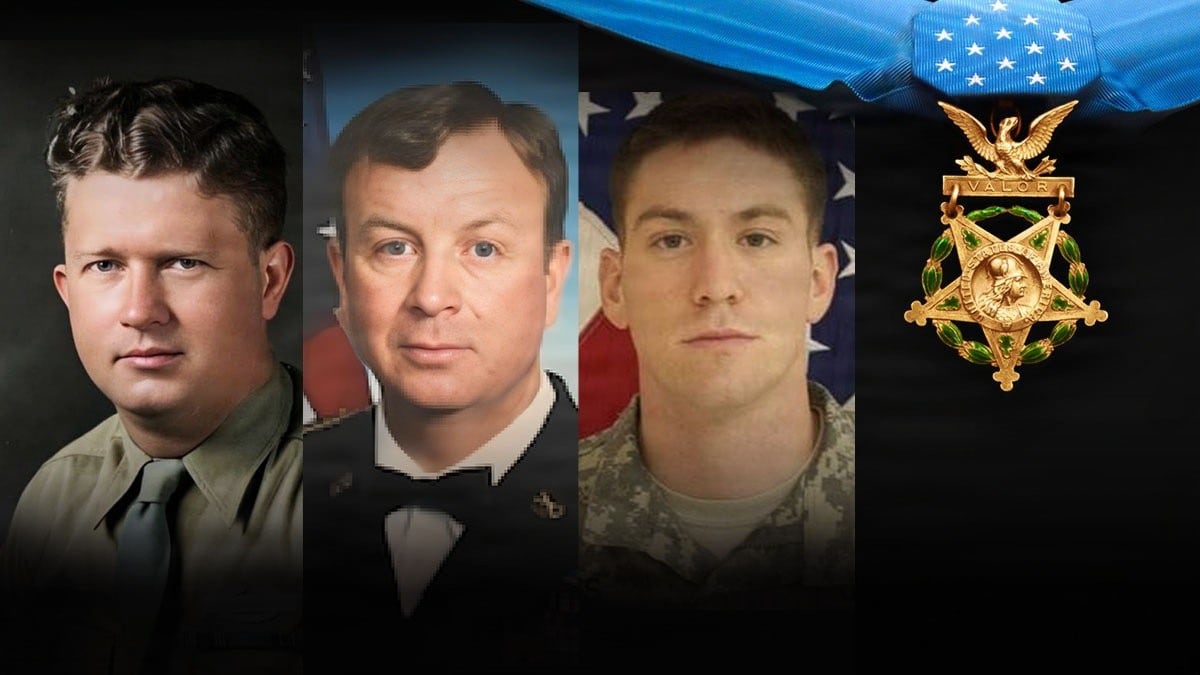
For his own part, LeBlanc learned that his action-packed day’s mission, including the first quintuple aerial victory by a Marine, had been observed by the bombers and a coastwatcher. This led his squadron commander, Maj. Paul J. Fontana, to recommend him for a Navy Cross and an Air Medal. The former was later upgraded to a Medal of Honor, which he received from President Harry Truman on Dec. 6, 1946.
DeBlanc was promoted to captain, effective May 31, 1943, then returned to States in June as a tactics instructor. He returned to a relatively placid combat zone with VMF-422 in the Marshall Islands in 1944, returning to more active climes in April 1945, when his unit moved on to Okinawa. His ninth and last victory was scored 5 miles south of Yokoate, Okinawa.
Ever the advocate of education, LeBlanc earned four degrees, including a Doctorate of Education from McNeese State University. He taught math and physics in American and European schools while retaining his reserve commission until his retirement as a colonel from the New Orleans Marine Air Group in 1972.
DeBlanc died in Saint Martinville, Louisiana, on Nov.7, 2007. In addition to an formidable lifetime of achievement — military and civilian — he left behind a family history. “Once They Lived by the Sword,” was published as a booklet in 1988 and his memoir, “The Guadalcanal Air War,” was published in 2008.