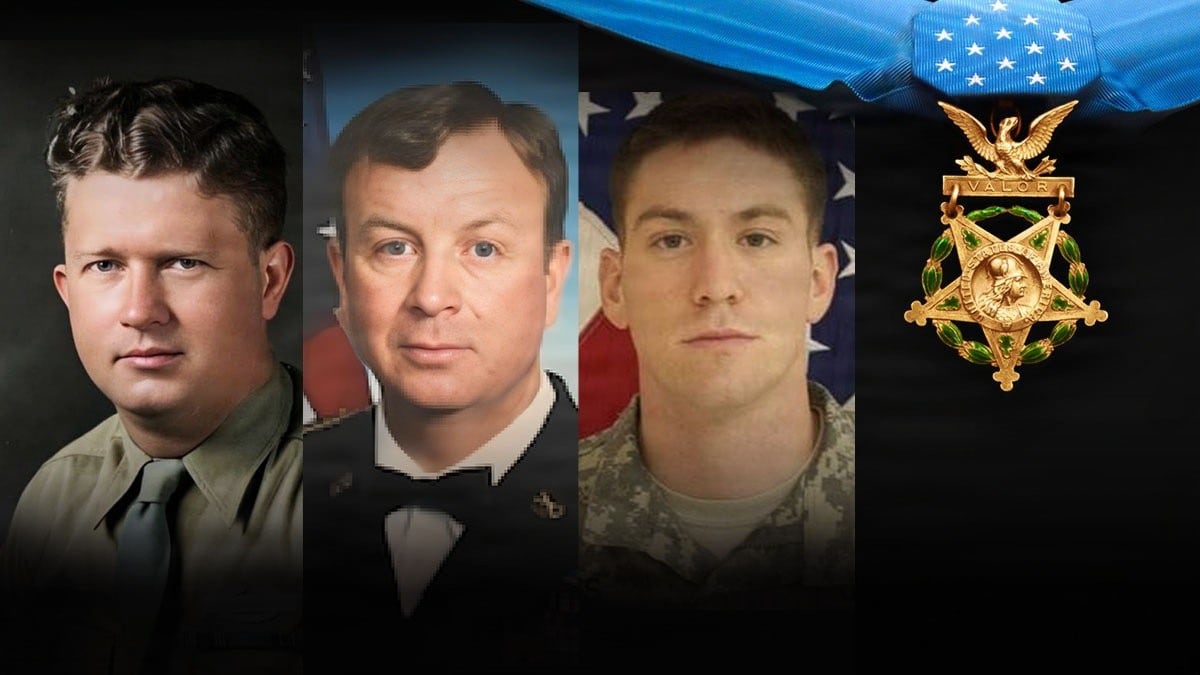
He landed on the beaches of Normandy and battled through the bitter European winter in the Hürtgen forest and yet, on Aug. 23, 1945, when President Harry S. Truman placed the Medal of Honor around the neck of U.S. Army, Staff Sgt. Marcario García, he was not yet a U.S. citizen.
Born on Jan. 2, 1920 in Villa de Castaño, Mexico, Marcario was one of 10 children born to Luciano and Josefa García. The family earned a living picking crops in Texas and in 1923 it moved to Sugar Land, mostly working at the Paul Schumann Ranch. On Nov. 11, 1942, however, Marcario walked to a recruiting station in his adopted hometown and enlisted in the U.S. Army. Although not a citizen, he already felt a personal obligation toward his adopted home.
After training, García was sent to Britain with Company B, 1st Battalion, 22nd Regiment, 4th Infantry Division. In June 1944, just a few days after landing at Utah Beach, he was seriously wounded and spent four months in hospital.
Returning to his unit that fall, García, although still a private, was serving as an acting squad leader. On Nov. 27, his unit was advancing on Grosshau, a town in the Hürtgen Forest, where the German forces were literally fighting with their backs to the wall.
As B Company advanced, it came under machine gun, artillery and mortar fire. Taking the initiative, García crawled forward through meager cover to reach an enemy machine gun emplacement, threw grenades into it and, when the crew tried to flee, killed three with his rifle.
Although wounded in the shoulder and the foot, García eschewed retiring to a medical facility, instead crawling on along until he located another machine gun position. Again, he threw some grenades into the emplacement and shot three more crewmen dead, also taking four prisoners. He then held his position until his squad had advanced and secured the ground he’d taken.
García’s performance didn’t go unnoticed in the 4th Division. By the end of the war, he was a staff sergeant and received the Purple Heart, Bronze Star and Combat Infantryman’s Badge.
On Aug. 27, he was one of 27 servicemen called to the White House to receive the Medal of Honor from President Truman. Still being a Mexican citizen, he was subsequently summoned to Mexico City to receive the Condecoración al Mérito Militar — Mexico’s award for exceptional military merit — on Jan. 8, 1946.
García’s fight, however, was far from over.
After his honorable discharge, in September 1945 García entered a restaurant in Richmond, south of Houston, and was denied service by the proprietor, who like a good many in the area, made a policy of: “We Serve White’s Only—No Spanish or Mexicans.”
At another time and place, García might have resigned himself to that commonly practiced degradation, but his wartime experience and the cause for which he’d fought had given him a new perspective on the matter. The ensuing argument came to blows, the police intervened and they promptly arrested García.
His case soon became a local cause celebre. The League of United Latin American Citizens and the Comitié Patriótico Mexicano financed his legal needs and he was represented in court by John J. Herrera and later, James V. Allred — the future governor of Texas. The trial was constantly postponed, however, and in 1946 the charges against García were dropped.
On June 25, 1947, García achieved American citizenship, the only Medal of Honor recipient to have received it as a Mexican citizen. Making the most of the opportunities now open to him, in 1951 he earned his high school diploma. After some difficulty finding a steady job — a common problem among returning World War II veterans in general — he found one as a counselor in the Veterans Administration, which he held for 25 years. In 1970, he and the family moved to Alief in southwest Houston, Texas.
On Christmas Eve in 1972, however, he was caught up in a car crash and died of his injuries. He was buried in the National Cemetery in Houston.
García’s struggles and achievements in war and peace earned him a posthumous places in Texan history. His burial was attended by an honor guard from Fort Sam Houston in San Antonio. In 1981, the Houston City Council changed 69th Street to Macario García Drive. In 1983, Vice President George H.W. Bush dedicated the Macario García Army Reserve Center and in 1994 a Sugar Land middle school was named in his honor.