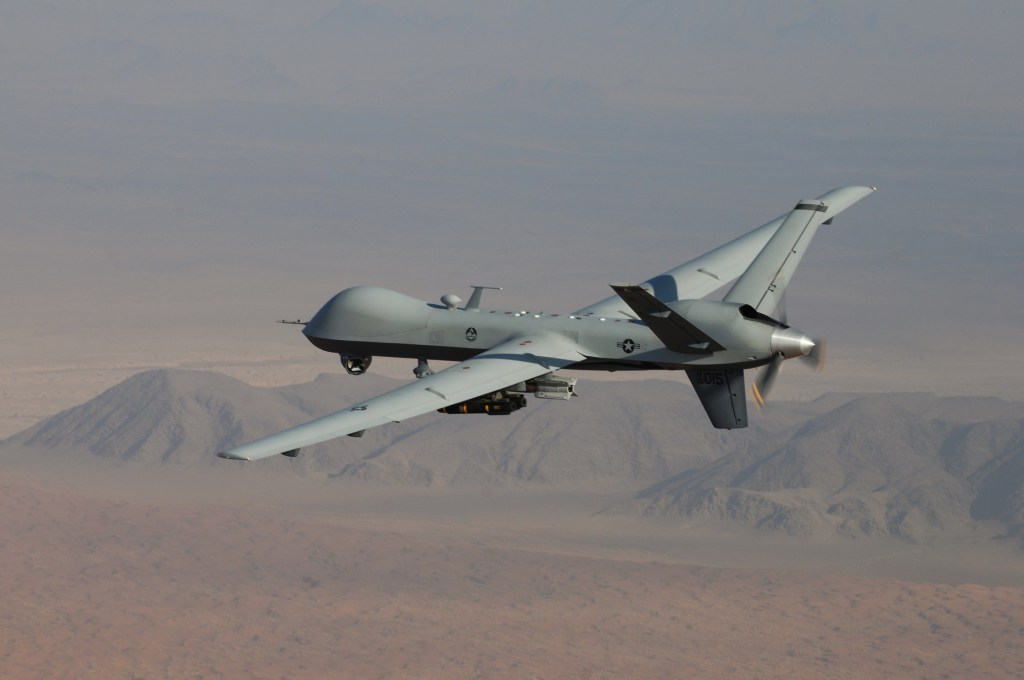
The remotely piloted MQ-9 Reaper was the workhorse in the U.S. air campaign against Iran, Air Force leaders told Congress on May 20, even as the service’s fiscal 2027 budget request still pours the bulk of aircraft dollars into crewed fighters.
Having repeatedly proven their worth, unmanned aircraft will “play an increasingly important role as we build out into the future across the board,” Secretary of the Air Force Troy Meink told the House Armed Services Committee. When Rep. Chrissy Houlahan, D-Pa., asked whether manned and unmanned systems represent the future of the Air Force, Meink answered, “Absolutely.”
Air Force Chief of Staff Gen. Kenneth S. Wilsbach went further on Operation Epic Fury. “Perhaps maybe the most valuable player was unmanned,” Wilsbach said. “No other platform is even close to the MQ-9,” he added, citing strikes that consistently reduced risk to pilots.
Rep. John Garamendi, D-Calif., wasted no time in challenging the gap between the Air Force’s praise for unmanned systems and the dollars allocated to them. “Gen. Wilsbach, you spoke very passionately when you answered the chairman’s question about UASs and their future,” Garamendi said. “However, your budget doesn’t follow that passion.”
Detailing the service’s budget requests, Garamendi cited “$1.4 billion for CCAs”; “$7.4 billion for the F-35s, most of whom will be delivered unable to have necessary equipment like radars”; and “$5 billion for the new F-47.” He suggested the Air Force “put your money where your mouth is” and asked Meink for written follow-up on Collaborative Combat Aircraft (CCA) scaling plans, F-47 integration timelines and research funding adjustments.
The FY27 request marks the first funding to buy CCA. The service seeks $996.5 million for procurement and roughly $1.37 billion in research and development, the single largest new addition to the Air Force’s $30.64 billion aircraft procurement account. The service aims for more than 150 CCAs by the end of the Future Years Defense Program.
By comparison, the request funds 38 F-35A fighters as part of a larger 85-aircraft joint buy, with the F-35A line dependent on a separate reconciliation bill.
While signaling a clear commitment to unmanned aircraft, the CCA budget request is a fraction of the crewed F-47 it would fly with.
The unmanned fleet doing today’s work, meanwhile, is shrinking.
The Reaper fleet has fallen to roughly 135 aircraft after 24 losses in Epic Fury that exposed the platform’s vulnerability to modern air defenses.
That puts the fleet roughly 54 aircraft below the service’s long-standing 189-aircraft floor. The losses are part of a broader toll of 42 U.S. aircraft lost or damaged in the campaign, according to a Congressional Research Service report.
A current MQ-9 with a full sensor package “can run up to $50 million a copy,” Maj. Gen. Christopher Niemi, military deputy for Air Force Futures, told a Senate Armed Services subcommittee on May 12, per Air Force Times.
By that figure, the 24 Reapers lost over Iran represent up to $1.2 billion in destroyed airframes, more than the $996.5 million the service seeks for new CCA.
Backfill options are scant. General Atomics shut down the MQ-9A production line in 2025 after the Air Force confirmed it would stop buying the platform, and a company spokesperson told Air & Space Forces Magazine the firm has fewer than 10 new or company-owned MQ-9As available to sell.
A successor to the MQ-9 is in early development. Niemi signed off on a requirements document on May 11, framing the next-generation platform as modular, open architecture, mass-producible and attritable.
Meink confirmed the service is not divesting the MQ-9. “We have had some losses in that aircraft, and we’re working to fill those losses,” he said, “but in parallel, we are looking at what is the follow-on to the MQ-9 aircraft. It’s probably going to be not one platform, it’ll probably be multiple platforms.”
For most of the past decade, the Air Force has retired aging aircraft faster than it has replaced them, betting that next-generation programs would arrive in time. The FY27 request is the first in years to fund both readiness and modernization at scale, with Meink citing a 34% boost to foundational readiness and Wilsbach a 27% jump in research and development.
The first CCA buy marks a turning point. Once defense contractors like Anduril and General Atomics are tooling production lines and Air Force squadrons are absorbing the aircraft, the manned-unmanned future of the Air Force becomes irreversible.
Whether the dollars adequately sustain Meink’s vision is the question Garamendi and others will keep asking.