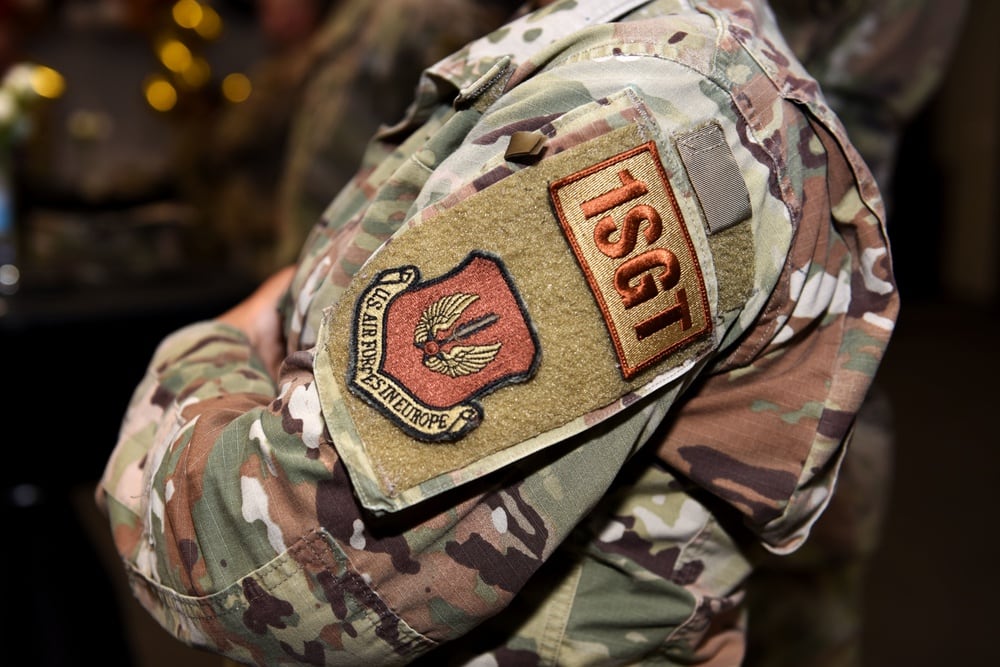
Airmen are once again allowed to wear patches indicating their primary job, reversing Air Force leadership’s move from a year ago to bar them.
The Air Force included the reinstatement of duty identifier patches in an update to its dress and personal appearance regulation released Friday, and said it was one of the most significant changes to the standards.
“I’ve decided to bring duty identifier patches back because the Air Force is made up of many different specialties, each with a unique role in our mission to generate airpower,” Air Force Chief of Staff Gen. Ken Wilsbach said in a statement. “We are a unified force working together to win.”
The Air Force posted a list of more than 90 authorized duty patches, signifying a wide range of jobs including air traffic control, security forces, cyberwarfare, navigators, intelligence surveillance and reconnaissance, and special warfare jobs like pararescuemen. The list also covered a dozen qualification tabs authorized, indicating airmen had qualified for duties such as being an instructor; recruiter; survival evasion resistance and escape, or SERE, specialist; or member of the honor guard.
The new standards say airmen in approved jobs can wear a subdued spice brown patch centered at the top of their Velcro area on the left shoulder.
Wilsbach’s predecessor as chief, retired Gen. David Allvin, announced in January 2025 that duty identifier patches were no longer authorized for wear. Soon afterward, he released a video that noted the number of those patches had swollen to more than 134 over the years.
“That is a lot of tabs,” Allvin said in that video. “Under the principle we have of easy to understand, easy to comply with, and easy to enforce: This fails that test.”
The Air Force’s current leadership takes a different view of the patches.
“Your expertise matters,” Chief Master Sergeant of the Air Force David Wolfe said in Friday’s statement. “These patches are a reflection of the skills you earned, and every patch tells a story that ends with ‘airpower.’ They connect your role to the larger mission. We trust you to wear them correctly and help your wingmen do the same — we owe each other accountability every day.”
The new uniform regulations also relax requirements for airmen to maintain a full set of the operational camouflage pattern uniform. Now, only airmen who are doing jobs or carrying out missions that require the OCP must keep a full set.
Airmen also can wear the watch cap, in either knit or fleece material, during cold weather conditions from October through the end of March, or when their installation commander approves its wear. Black watch caps can be worn with Class A and B uniforms, OCPs or physical training gear. The alternative color, coyote brown, can be worn with OCPs or PT gear, the Air Force said.
Airmen are allowed to wear glasses or sunglasses with black, brown, white, dark blue, gray or transparent frames, or gold or silver wire frames, the service said. Sunglasses must be either traditional gray, brown or dark shades. Airmen are not allowed to wear mirrored lenses or smart glasses with photo, video or artificial intelligence capabilities while in uniform, the service said.
And in most cases, airmen are only allowed to wear and use earbuds, earpieces, headphones or Bluetooth wireless technology when authorized for official duties. They are not to use personal electronic media devices, such as earpieces, speaker phones or text messaging, while walking in uniform unless it is an emergency or official notifications are necessary, the service said.
The Air Force said airmen who are traveling on public transportation or exercising while wearing physical training gear have an exception to use headphones and earphones, although the usual military customs and courtesies take precedence.
Stephen Losey is the air warfare reporter for Defense News. He previously covered leadership and personnel issues at Air Force Times, and the Pentagon, special operations and air warfare at Military.com. He has traveled to the Middle East to cover U.S. Air Force operations.