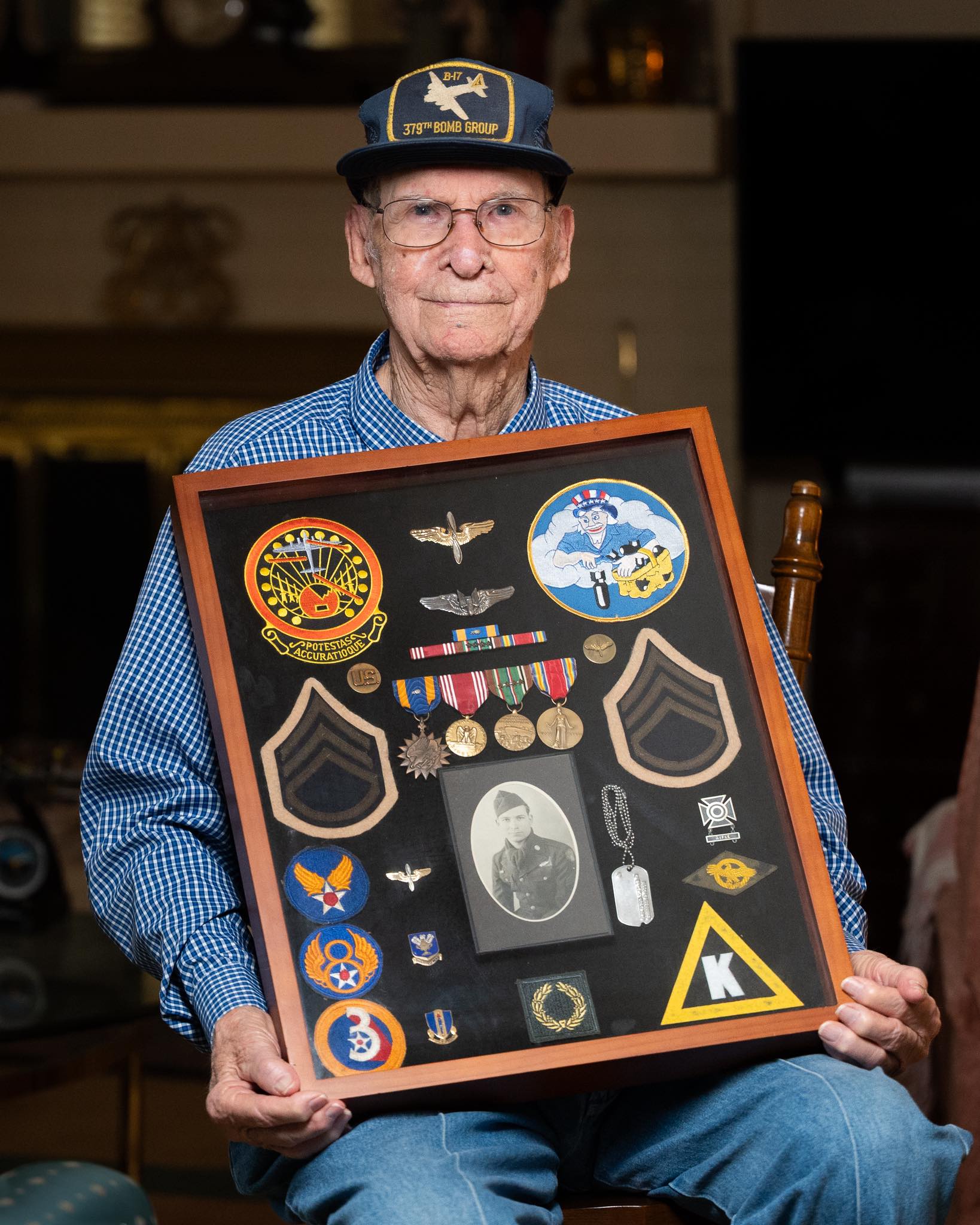
At 18 years old, Staff Sgt. Phillip “Bruce” Cook flew 35 missions as a ball turret gunner in a B-17 Flying Fortress, tasked with fighting for air supremacy over occupied Europe. Now, more than 80 years after his last mission, Cook has received France’s highest military award becoming a Knight of the Legion of Honor.
The 100-year-old South Carolina native received the National Order of the Legion of Honour on April 9 from Anne-Laure Desjonquères, the French consul general, who noted “Mr. Cook, you are a true hero — your example gives us inspiration for the future and your legacy provides a moral compass for generations to come.”
First established by Napoleon Bonaparte in May 1802, The Order is the highest decoration in France and is divided into five degrees: Chevalier (Knight), Officier (Officer), Commandeur (Commander), Grand Officier (Grand Officer) and Grand Croix (Grand Cross).
Roughly 10,000 Americans have been awarded France’s highest distinction, with most recipients being World War II veterans who played a role in liberating France.
“There is no way that I can even attempt to explain the feeling,” Cook said at the ceremony. “As far as I’m concerned, I am so unworthy. I want to be a representative of the people who didn’t come back. They are the ones who paid the real sacrifice.”
For three years, from 1942 to 1945, daylight bombing runs by the 8th’s Flying Fortresses over Nazi Germany unleashed 697,000 tons of bombs.
Of that total, more than 47,000 were from the 8th.
Of that 47,000, the 379th Bomb Group — of which Cook was a part of — dropped 26,459 tons.
The effort to pry the claws of the Third Reich from Europe was met with deadly resistance, prompting torturous contemplation of one’s own mortality while being confronted with casualty totals that, by war’s end, would exceed 115,000 personnel from the U.S. Army Air Force.
Despite such odds, Cook told the WWII Veterans History Project, “Anytime I got in that plane and we took off, I told myself that I’m coming home. That was my attitude.”
Enlisting in the U.S. Army Air Forces in 1943, Cook had dreams of becoming a P-38 fighter pilot. However, according to Cook’s account in the WWII Veterans History Project, he washed out of cadet training for what the Army called a “negative attitude regarding military aviation.”
Undeterred, the slender, 138-pound Cook found his way back to aviation, this time as an aerial gunner in the belly of the four-engine bomber.
“To me that was the most comfortable place in the plane. I was accustomed to that. I fit in it pretty good,” Cook told ABC 25 Columbia.
Flying with the of 524th Bomb Squadron, 379th Bomb Group, 8th Air Force out of Kimbolton, England, Cook participated in the bombings of enemy rail yards, airfields, factories, communication centers, synthetic fuel factories, rocket sites and enemy troop concentrations within France, Germany, Czechoslovakia and Holland.
According to the South Carolina legislature, the 379th’s combat record “was the most successful of all the 8th Air Force heavy bomber groups. The unit held records as far as bomb tonnage dropped … and exceeded all other United Kingdom-based Bomb Groups in the total number of missions flown, carrying out 330 missions between May 1943 and May 1945.”
Cook participated in the air cover during the Battle of France, bombing enemy positions from Normandy through the breakout at St. Lo, as well as during the Battle of the Bulge and the Allied assault across the Rhine River into Germany.
“We would bomb just about anything that would disrupt the [German] war effort,” he explained to the Veterans Project.
Cook flew his last mission — his 35th — on Feb. 16, 1945, and was discharged in October of that year. The veteran returned home to Lexington, South Carolina, where he ran a jewelry store for more than 20 years before his retirement in 1983.
“The Lord’s just been good to me,” said Cook at the ceremony last Thursday. “I have really enjoyed life, and I just thank the Lord for what he’s done for me.”