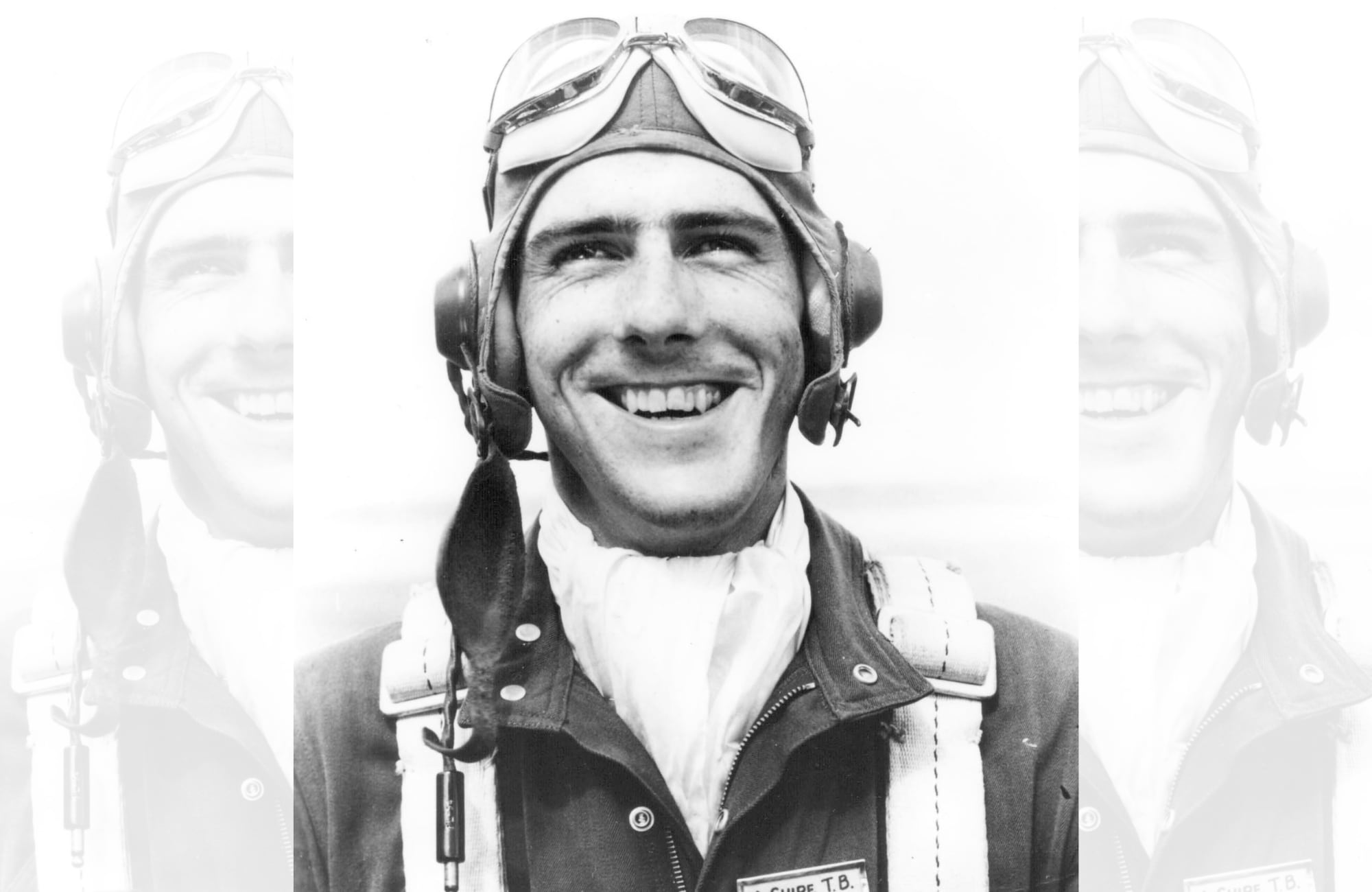
“On 7 January 1945, while leading a voluntary fighter sweep over Negros Island, he risked an extremely low altitude in an attempt to save a fellow flier from attack, crashed and was reported missing in action.” This was the last of several citations summarizing the deeds that added up to a Medal of Honor for Maj. Thomas McGuire Jr.
It also chronicles a culmination of ambition and hubris that ended the brilliant career of the second-ranking fighter pilot in the United States air services.
Born in Ridgewood, New Jersey, on Nov. 17, 1920, McGuire attended the Georgia School of Technology for three years, then enlisted in the U.S. Army Reserves as a flying cadet on July 12, 1941. On Feb. 2, 1942, he was rated a pilot and second lieutenant at Kelly Field, Texas.
While training at San Antonio, he met and married Marilynn Giesler, who he nicknamed “Pudgy,” a sobriquet that would appear on all his fighters thereafter.
From June 18 to Oct. 16, he flew Bell P-39Fs with the 56th Squadron, 54th Pursuit Group in Nome, Alaska, but on March 13, 1943, he was reassigned to warmer climes in the 9th Squadron, 49th Fighter Group, over Papua New Guinea.
Flying his first combat mission on April 22, McGuire was transferred to the newly formed 431st Squadron, 475th Fighter Group in July that year. Nicknamed “Satan’s Angels,” the 431st flew all over the South Pacific on missions that ranged from escorting bombers to making fighter bomber sweeps, according to the Department of Defense.
Flying the P-38H-1, he finally scored his first aerial successes on Aug. 13 — downing three enemy planes. The following day he shot down two more, becoming an ace in less than 48 hours.
He scored regularly from then on, becoming a first lieutenant that September.

On Oct. 17, 1943, he downed three Zekes over Oro Bay, raising his tally to 10, but was himself shot down and wounded. Parachuting 25 miles from Buna, he was rescued half an hour later by a patrol torpedo boat.
McGuire was promoted to captain on Dec. 10, and major on May 23, 1944. He held command of the 431st from May 2 to Dec. 23, then became group operations officer for the 475th.
By October that year, McGuire had shot down 24 enemy planes but was trailing Maj. Richard I. Bong whose tally was at 30.
At this point, McGuire had his eyes on surpassing Bong and the commander of the Far East Air Force, Lt. Gen. George C. Kenney, was inclined to encourage the rivalry, which brought attention to his Fifth and Thirteenth Air forces.
Kenney had known Bong before the war and favored him by making him weapons officer for V Fighter Command. In practice, it gave Bong a roving commission to fly and fight when and where he pleased. In contrast, McGuire took on all the responsibilities of command, while still finding time to shoot down enemy aircraft.

December 1944 saw the aces reach their peak. On Dec. 12, Bong was presented the Medal of Honor by Gen. Douglas MacArthur. But on Dec. 17, with Bong achieving his 40th aerial victory, Gen. Kenney ordered him to walk away from his P-38.
When McGuire shot down four Zekes on the 26th, raising his score to 38, Kenney grounded him to allow Bong one more crack at the title following his war bond tour back in the States.
Once Bong had finished his tour, however, Kenney unleashed McGuire, who gleefully resumed his patrolling.
On the morning of Jan. 7, 1945, McGuire led three P-38Ls over the area between the Philippine islands of Mindoro and Negros at an altitude of 1,500 feet.
There, Capt. Edwin Weaver spotted an enemy plane climbing toward them. McGuire and Weaver turned to attack it, but the Japanese Ki.43 evaded them and fired a burst of 12.7 mm bullets into the left engine of 1st Lt. Douglas S. Thropp Jr.’s P-38.
Thropp skidded, then straightened out and prepared to release his drop tanks.
“Daddy Flight, save your tanks,” McGuire ordered over the radio — confident that he could make short work of the enemy.
The fourth P-38, flown by a visiting 13th Air Force pilot, Maj. Jack Rittmayer, drove the Ki.43 off Thropp’s tail, but Japanese pilot pivoted to attack Weaver.
Hastening to Weaver’s aid, McGuire pulled his plane into a tight turn. Just as he was about to get his sights on the elusive enemy, his P-38 — weighted down from those extra fuel tanks — abruptly fell into a stall, snap-rolled onto its back and crashed in flames on Negros Island.
After 325 grueling missions, McGuire was reported as missing in action. Prior to his death the ace had earned the Distinguished Service Cross, the Silver Star, the Distinguished Flying Cross with four oak leaf clusters, 15 Air Medals and two Purple Hearts.
On March 7, 1946, for several outstanding actions, ending with his risking — and ultimately sacrificing — his life to save Weaver, he was posthumously awarded the Medal of Honor.
McGuire’s remains were discovered in 1949 in the jungles of Los Negros near a pineapple plantation, according to the DoD. In the same year, Fort Dix Army Air Field was renamed McGuire Air Force Base. McGuire’s remains were laid to rest in Arlington National Cemetery on May 17, 1950.