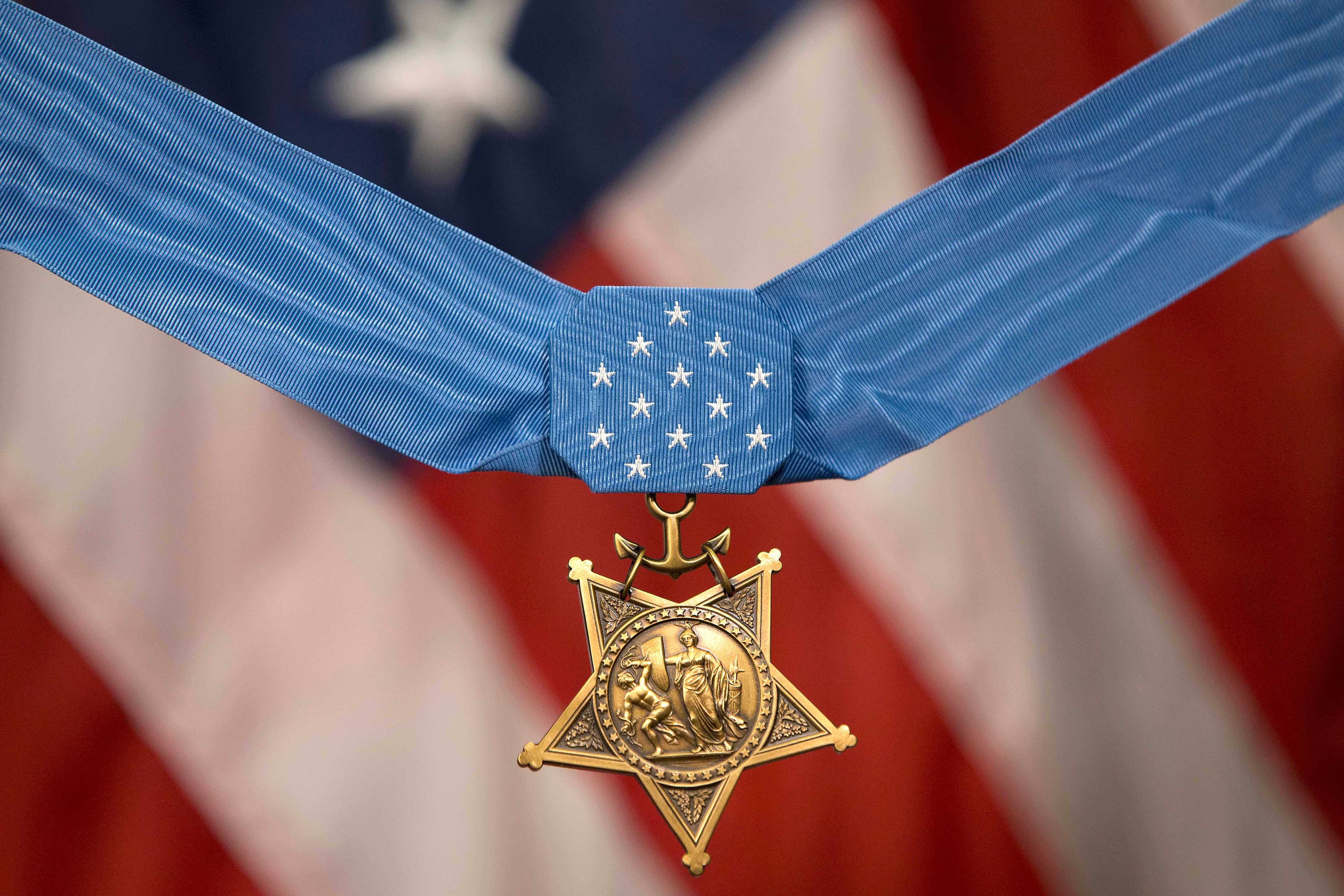
After more than 80 years — and a decade after he was recognized by Yad Vashem as one of the “Righteous Among the Nations” — Roddie Edmonds will posthumously receive the Medal of Honor, a White House official confirmed to Military Times on Thursday.
A master sergeant serving in the 106th Infantry Division, 422 Regiment Headquarters Company, Roddie Edmonds had been serving along the Siegfried Line in Bastogne, Belgium, for a mere six days in December 1944 when the Germans began their fanatical final offensive of World War II.
He, alongside thousands of other Americans, were captured by the Germans during the Battle of the Bulge — the largest capture of GI forces during the entirety of the war.
The master sergeant kept a diary of his time in captivity, but his story may have stopped there, alongside its writer who died in 1985, if one simple sentence in a 2008 New York Times article hadn’t set his son, Christopher Edmonds, on a mission to discover what his father had done during the Second World War.
A son’s mission
“He never really talked about his experiences in World War II,” Christopher Edmonds recalled of his father in a 2016 documentary, “or his time as a prisoner of war. He would say, ‘Son, there are some things that I’d rather not talk about.’”
It wasn’t until the late 2000s that Christopher Edmonds began to search further into his father’s story. It was then that he came across a 2008 article not regarding the war, but, of all things, a story regarding Richard Nixon’s real estate troubles. There, buried within the story, was an offhand mention of lawyer Lester Tanner and his war record.
Curiosity set in for Christopher Edmonds with the line: “Mr. Tanner recalled it, their brave officer, Master Sgt. Roddie Edmonds, defied the camp commander, saying the Geneva Convention forbade the request, and Mr. Tanner and his fellow prisoners were spared, to be liberated shortly afterward.”
It was shortly after that he connected with Tanner, Irwin “Sonny” Fox, Lester Tannenbaum and Paul Stern who had silently kept Roddie Edmonds story alive in their minds for decades.
WE ARE ALL JEWS HERE: THE STORY OF RODDIE EDMONDS
— U.S. Army (@USArmy) December 21, 2020
Told by the @18airbornecorps #BattleoftheBulge https://t.co/aRKRn4afka
Germany by way of the Bulge
On the front line, about 10 miles from division headquarters in St. Vith, Roddie Edmonds’ war came to him with terrifying swiftness. Encircled, the company’s captain made the decision to capitulate in the face of overwhelming German firepower, namely tanks.
From there, Roddie Edmonds was shipped alongside his men in cattle cars that were also used to transport Jewish prisoners to concentration and death camps.
Eventually transported to Stalag IX-A, the Americans subsisted on one loaf of bread per 10 men.
“You went to bed hungry. You woke up hungry. You were hungry forever,” Tannenbaum recalled in the documentary.
Tanner noted that during his three months in captivity he lost over 60 pounds.
It was within these conditions that the POWs subsisted until roughly one month after their capture, on Jan. 27, 1945, when Roddie Edmonds, the highest-ranking American noncommissioned officer at Ziegenhain stalag that day, was told to order his nearly 200 Jewish-American soldiers out of the morning roll call.
Instead, the master sergeant ordered more than 1,000 of his fellow prisoners to stand together in front of their barracks.
The commandant scoffed, noting that they couldn’t all be Jewish.
Roddie Edmonds was defiant, telling the Nazi: “We are all Jews.”
The commandant furiously marched over to the master sergeant, placed his Luger to Roddie Edmonds’ forehead and once again told him to order his Jewish soldiers to step forward or this time he would execute him.
“You can shoot me,” Tanner, who was standing next to Roddie Edmonds at the time, recalled the NCO saying. “You can shoot all of us. But we know who you are. And this war is almost over, and you’ll be a war criminal.”
The Nazi slowly lowered his pistol, did an about-face, and walked away.
It would not be the first time, however, that Roddie Edmonds’ defiance and quick thinking would spare his men.
In March 1945, as the last gasps of the bloody war were drawing to a close, the Nazis of Stalag IX-A ordered the forced march of the entire camp.
Weakened by months of captivity, Roddie Edmonds knew the march would be a death sentence for many.
While the British, French and Russians began to evacuate the camp, the Americans stayed put.
On the day of the evacuation, the master sergeant ordered his men break ranks and run back into the barracks. Back and forth they went. Ordered out. Running back in.
After several hours of this the Nazis miraculously relented, leaving the Americans as the sole inhabitants of Stalag IX-A.
Days later, on March 30, 1945, the men were liberated by the advancing 6th Armored Division. They would never meet one another ever again, yet Roddie Edmonds’ acts of courage stayed with the men.
In 2016, he was recognized by Yad Vashem as “Righteous Among the Nations” — an honorific title bestowed to non-Jewish persons who risked their lives in order to save Jews.
Now, for his acts of courage and defiance, Roddie Edmonds will receive the Medal of Honor.
“That such people can exist,” Stern noted in 2016, “gives you hope for humanity.”
Claire Barrett is an editor and military history correspondent for Military Times. She is also a World War II researcher with an unparalleled affinity for Sir Winston Churchill and Michigan football.