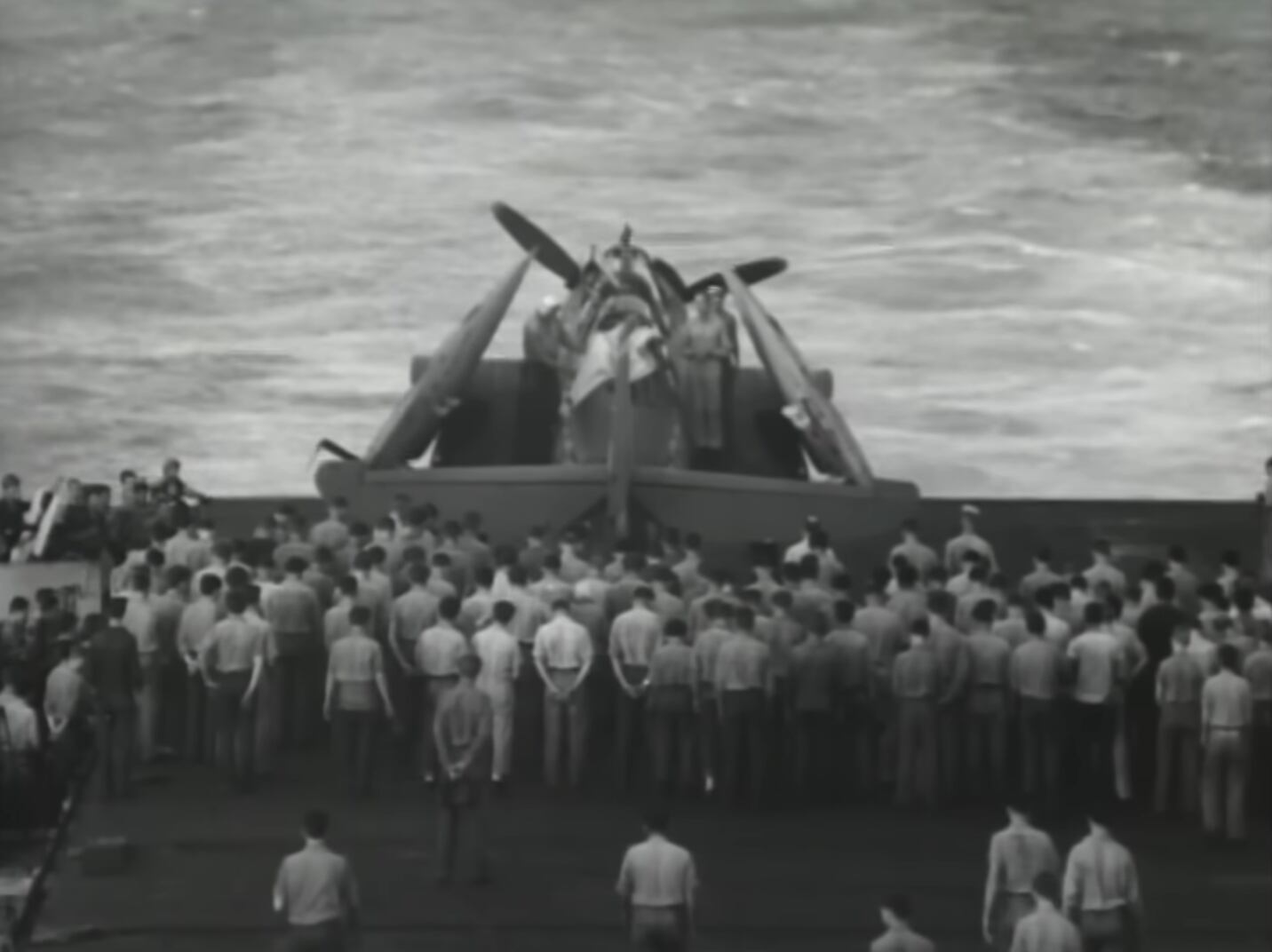
It was a blink-and-you’ll-miss-it moment. In episode 12 of “Victory at Sea,” the 1953 documentary series captured several solemn burials at sea — but one naval burial stood out from the rest.
Twenty-three-year-old Loyce Edward Deen, an aviation machinist mate, was the first and only aviator buried at sea inside his airplane. It was part necessity — his TBM Avenger was so badly shot up by 40mm anti-aircraft shells that the removal of Deen would have been almost impossible — but the U.S. Navy took it one step further to honor its slain shipmate. According to a memorial page dedicated to Deen, orders came down not to strip the plane for parts, a rare occurrence during a time when the demand for scrap metal was high.
Born in Altus, Oklahoma, Deen was struck by a series of tragedies during his childhood. In 8th grade, Deen’s younger brother became ill and died within a few days. Then, in October 1938, his mother suffered a debilitating stroke that left her paralyzed. Deen, alongside his other brother, cared for his mother until her subsequent death just one month later.
After graduating from high school, Deen joined the Civilian Conservation Corps, but he had always eyed joining the Navy and, less than a year after the attack on Pearl Harbor, he shipped out to complete basic training in San Diego.
In a 2015 interview, Deen’s niece, Bertha Deen Sullivan, recalled, “I was just a little girl when he left, and he picked me up and hugged me and said, ‘I will see you later.’”
He attended gunner school to learn how to shoot from an A-26 Invader and by 1944 Deen had shipped out to the Pacific aboard the USS Hornet.
Assigned to Air Group 15 aboard the USS Essex, dubbed the “Fightingest Ship in the Navy,” Deen first saw combat during the swirling, chaotic October 1944 battle of Leyte Gulf.
Valdemar Lambert, squadron commander of VT-15, later recalled of the battle: “Coming in through the most intense and accurate AA yet experienced, the squadron made three hits on one battleship, two hits on another battleship, and two hits each on two different heavy cruisers.”
During that time, shrapnel struck Deen in his foot. Given the choice to recuperate on a hospital ship, Deen simply tied a bandage to his wound to stay with his crew, pilot Lt. Robert Cosgrove and radioman Digby Denzek.
Made a turret gunner for a torpedo bomber shortly after that battle, Deen, still visibly wounded, headed to Manila Bay on Nov. 5, 1944, alongside Cosgrove and Denzek. He would not return alive.
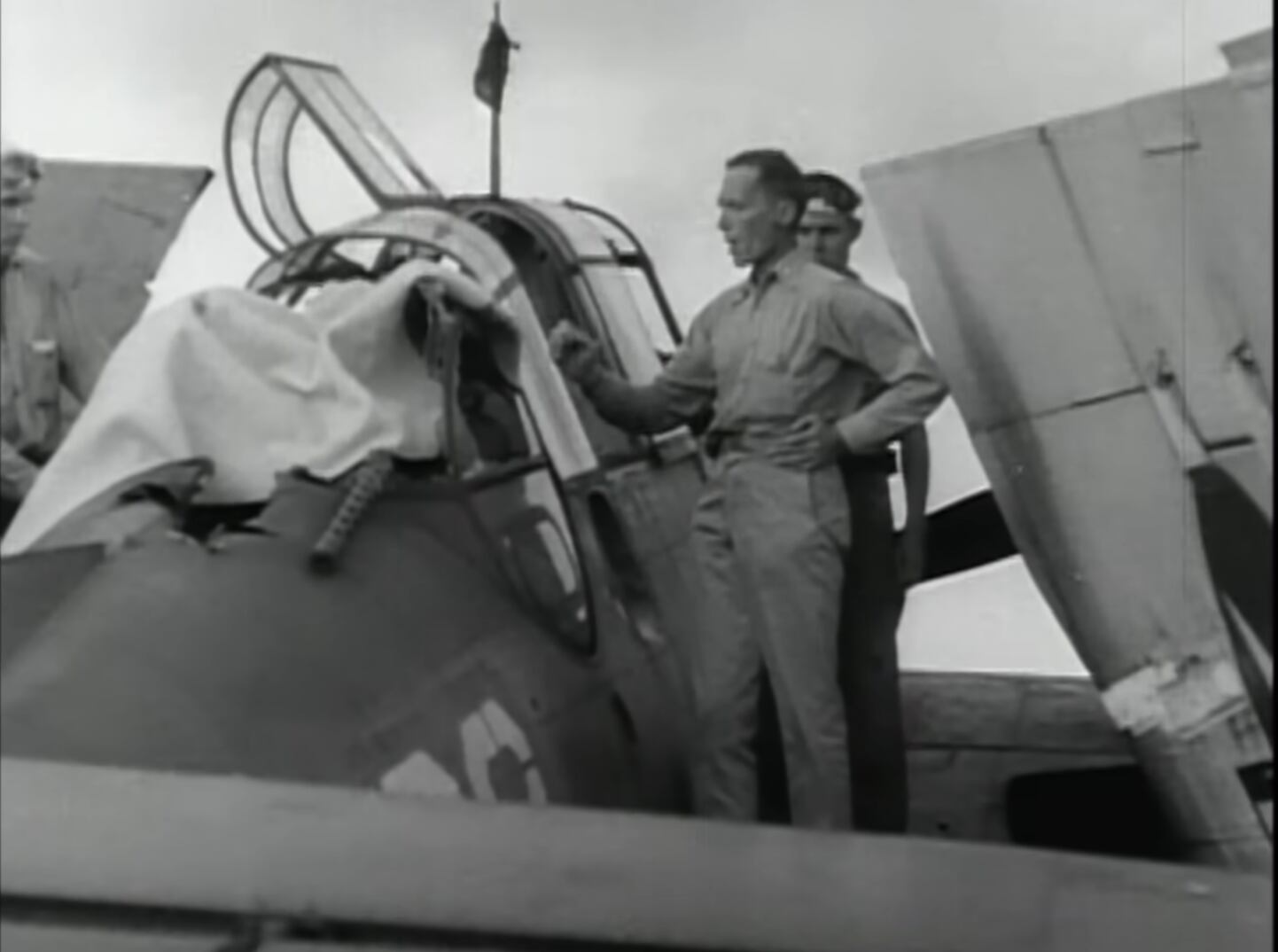
“We were told there were Japanese cruisers, destroyers in Manila Bay that had not been damaged, but they were fully manned and ready to fight. … We didn’t know that ‘til we made a run on ‘em,” Cosgrove recalled in the documentary, “Bull Halsey: The Navy’s Fearless Admiral of WWII.”
As Cosgrove made to dive down into his run, a Navy cameraman miraculously managed to capture the last few minutes of Deen’s life.
“We thought it was going to be real easy. We got down low and made our run in. And the ships opened up with all their anti-aircrafts,” Cosgrove recalled.
A Japanese shell exploded in the turret of Cosgrove’s Avenger. Tragically, Deen was decapitated.
“My radioman said, ‘Ohh, Deen’s been hit bad. … I’ve got teeth and stuff raining down on me down here.’ And I told him, get out, get out there because of course the body was still sitting in the turret, right over his head, running blood all over everything,” Cosgrove recalled.
Cosgrove managed to finish the run and turn back toward the Essex — an almost two-hour return flight. The pilot urged his battered plane on, radioing ahead that he was coming back with a gruesome scene.
While the men aboard the Essex were surrounded by death, the ghastly scene shook even the most hardened veteran.
According to the “Bull Halsey” documentary, within 15 minutes of the plane’s return the decision was made to leave Deen in place.
Less than an hour later, wind muted the ship’s chaplain as he issued a blessing, but it was nothing the sailors hadn’t already heard. Then, the Avenger, with Deen inside, was pushed into the sea and his fellow shipmates bid him fair winds and following seas.
Deen’s name is inscribed on the Walls of the Missing at the Manila American Cemetery and Memorial in Manila, Philippines.
Claire Barrett is an editor and military history correspondent for Military Times. She is also a World War II researcher with an unparalleled affinity for Sir Winston Churchill and Michigan football.