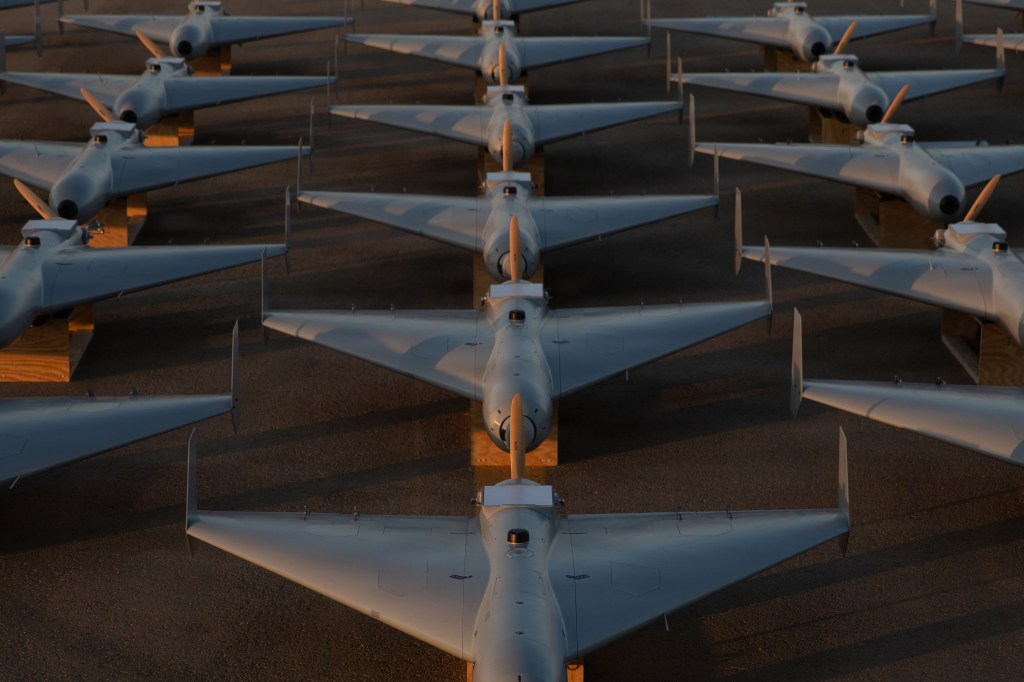
U.S. Central Command officials have confirmed that airstrikes launched on Iran on Saturday involved the first combat use of the U.S. military’s new autonomous kamikaze drone.
The Low-cost Unmanned Combat Attack System, or LUCAS drone, was launched as part of Operation Epic Fury, which targeted Islamic Revolutionary Guard Corps command and control facilities, Iranian air defense capabilities, missile and drone launch sites and military airfields, CENTCOM officials announced.
“The president ordered bold action, and our brave soldiers, sailors, airmen, Marines, guardians, and Coast Guardsmen are answering the call,” Adm. Brad Cooper, commander of CENTCOM, said in the release.
The LUCAS platform is a one-way attack drone reverse-engineered after the Iranian Shahed-136.
Built by the Arizona-based SpektreWorks, the drone, which can be launched via catapults, rocket-assisted takeoff and mobile ground systems, is a spinoff of the company’s FLM 136 target model, one designed for counter-drone training while simulating Iran’s Shahed variant.
The FLM 136 model carries a range capability of around 500 miles, with a maximum payload of 40 pounds, or “roughly twice the explosive yield of a hellfire missile,” according to Alex Hollings, host of Sandboxx News’ FirePower.
With a maximum takeoff weight of 180 pounds, the FLM 136 is significantly lighter than the Iranian Shahed. The platforms are also immensely more cost-effective — and scalable — compared to the more advanced munitions in the U.S. arsenal, carrying a price tag of around $35,000 per unit.
The U.S. Navy’s use of costly interceptors in recent years against Shaheds fired by Houthis into the Red Sea has prompted increased scrutiny of the cost trade-offs of such exchanges.
Iran’s stockpile of unmanned Shahed drones is immense, with the Islamic Republic reportedly producing 10,000 per month. Contrast the $35,000 average cost of an Iranian Shahed drone with an estimated $4 million price tag of a land-fired PAC-3 interceptor, and the cost exchange, if engaged, is 114-1 in favor of Iran.
And while the LUCAS drone is a strike munition, its deployment marks a considerable shift toward a cost-effective philosophy that could soon see cheaply-made interceptor drones, such as those being used to great effect in Ukraine, fielded by U.S. forces.
Soaring casualties in Ukraine, as well as lopsided military spending by Russia, have forced Kyiv to rethink its battlefield approach.
As of February, Ukrainian commanders say strike drones now account for 60% to 70% of all hits on Russian targets. Similarly, cost-friendly interceptor drones, some of which run as little as $1,000 each, experienced a 70% success rate in downing Iranian-made Shaheds in February.
The U.S.-made LUCAS drone, meanwhile, was successfully launched from a ship for the first time in December, with personnel aboard the Independence-class littoral combat ship USS Santa Barbara carrying out an exercise in the Arabian Gulf, the Defense Department previously announced.
Those troops make up the newly formed Task Force Scorpion Strike squadron, a first-of-its-kind one-way-attack drone squadron led by U.S. Special Operations Command-Central personnel.
“This new task force sets the conditions for using innovation as a deterrent,” Cooper said in a December release. “Equipping our skilled warfighters faster with cutting-edge drone capabilities showcases U.S. military innovation and strength, which deters bad actors.”
The establishment of the task force in December followed a directive months earlier by Defense Secretary Pete Hegseth, “Unleashing U.S. Military Drone Dominance,” to accelerate acquisition and fielding of affordable autonomous systems throughout the military services.
“To simulate the modern battlefield, senior officers must overcome the bureaucracy’s instinctive risk-aversion on everything from budgeting to weaponizing and training,” Hegseth wrote in the July memo. “Next year I expect to see this capability integrated into all relevant combat training, including force-on-force drone wars.”
The Navy’s operations in U.S. Central Command comprise around 2.5 million square miles of ocean and include the Arabian Gulf, Gulf of Oman, Red Sea and parts of the Indian Ocean.