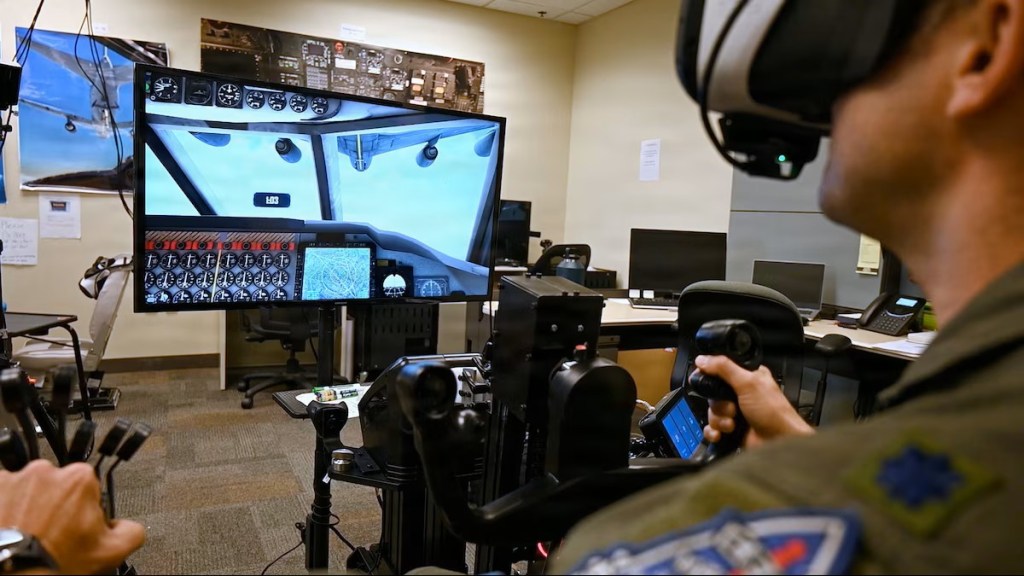
The U.S. Air Force aims to cut down on fuel costs for training scenarios using a virtual reality system — the Experiential Air Refueling Lightweight simulator, also known as EARL.
The system, developed by Specular Theory, is now being widely implemented across the service and used to train co-pilots and aircraft commander candidates. As of this month, it has been adopted by eight operational wings and commands, including Air Force Global Strike Command, Air Force Reserve Command and Air Mobility Command.
It has also been fielded at installations with critical strategic significance, including Joint Base Elmendorf-Richardson, Alaska, central to U.S. force projection in the Arctic, and at Minot Air Force Base, North Dakota, the service’s only dual-wing nuclear capable base.
EARL creates a realistic flight environment to train air crews how to perform maneuvers to refuel their aircraft in flight. To approach a tanker in flight and refuel is extremely challenging and demands a high level of skill.
It can be risky even for well-trained pilots. Last July, crews of an F-22 Raptor and a KC-46 Pegasus tanker aircraft had a close call when the tanker’s fuel pump got stuck inside the F-22 in midair during refueling, forcing an emergency breakaway. No one was injured, but the incident underscored how challenging that refueling can sometimes be.
In the past, mastering the art of refueling a plane in midair demanded many flight hours for practice that burned up “tens of thousands of pounds of fuel per sortie,” according to the service.
While airmen previously had the option to train on simulators, most of these systems consisted of large equipment sited in locations that took time and effort for service members to get to.
The EARL system is lightweight and about the same size as an exercise bicycle, making it simple to transport and set up. It creates an immersive experience for airmen, mimicking the exact aerodynamics and flight controls of specific aircraft while giving them training instructions. The system uses artificial intelligence to provide step-by-step guidance.
EARL has several companion systems — including the Boom Air Refueling Trainer, alternatively known as BART, which is geared for training boom operators.
The system allows pilots at different installations to train together in real-time. For example, pilots and boom operators can practice joint refueling missions in different virtual aircraft in synchrony using the simulators.
“Innovative platforms like EARL are fundamentally altering how we view training and energy resources across the enterprise,” Jim Hartle, associate deputy assistant secretary of the Air Force for operational energy, said in a statement.
“Our warfighters need to maximize operational capability with every gallon of fuel we consume,” he continued. “By moving repetitive proficiency rehearsals into trainers directly at the squadron level, we are taking strain off our tanker fleet, saving millions of gallons of fuel and ultimately returning those flying hours to high-end combat and tactical employment.”
The Air Force has stated its intention to expand the use of simulators and work to develop software for high-pressure combat scenarios, including tactical airdrops, takeoffs from rough terrain and short-field assault landings.