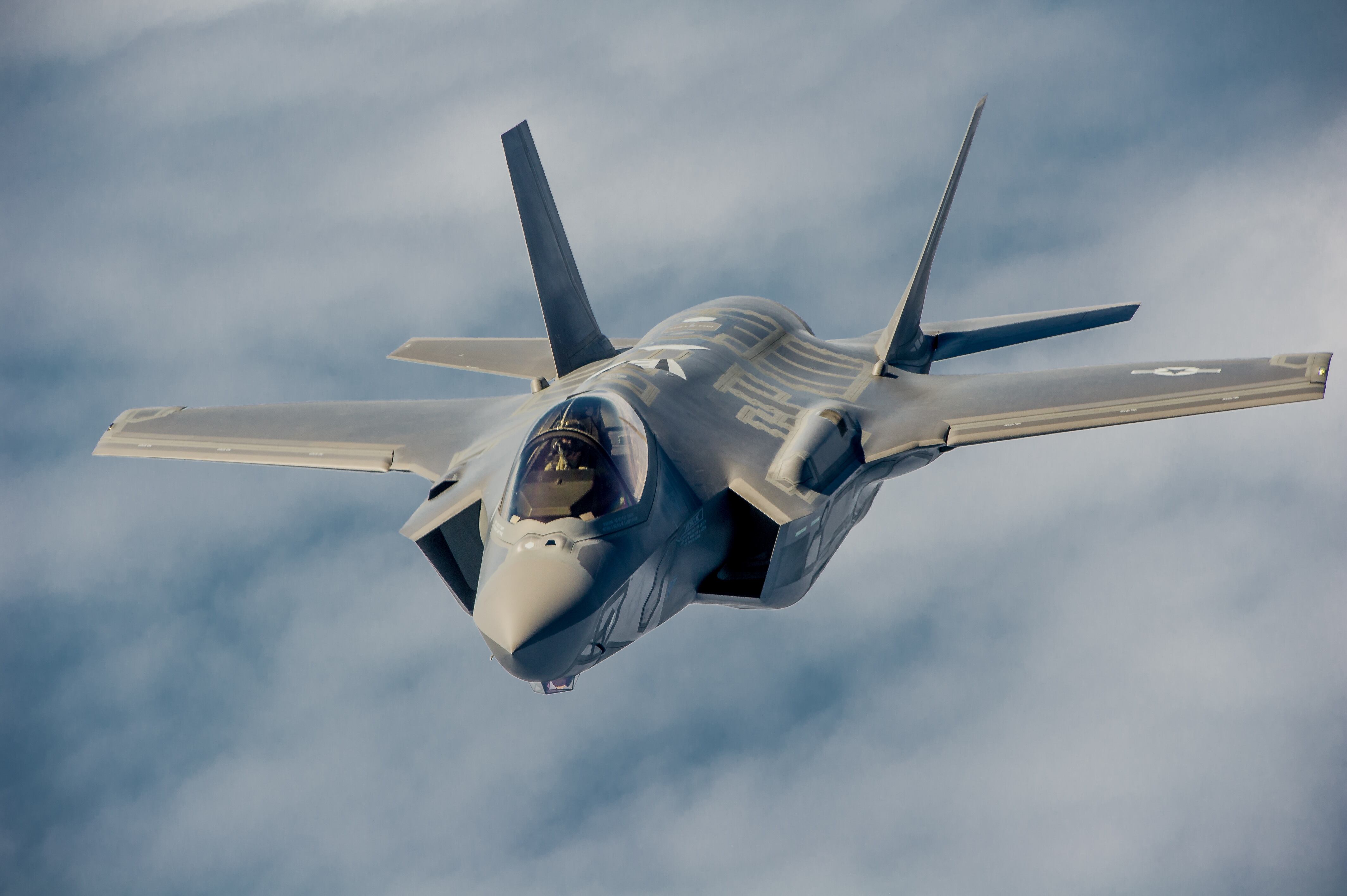
WASHINGTON – The F-35 joint program office (JPO) announced Tuesday evening that it has reached an agreement with engine manufacturer Pratt & Whitney on two key milestones — identifying the root cause of an engine issue that caused a fire in June, and on a contract for the next lot of engines for the stealthy fighter.
It hasn't been an easy summer for Pratt. In June, a fire broke out on an F-35A model, eventually leading the grounding of the fleet and a missed opportunity to give the jet an international debut at the Farnborough International Airshow.
Eventually, investigators concluded the cause of the fire were "microcracks" in the engine caused by certain flight maneuvers. The fleet has since resumed flying, albeit under restrictions that Bogdan has warned could lead to test delays if they are not resolved in short order.
A fix for the engine has been expected, with a Pratt executive outlining potential designs for reporters during September's Air Force Association conference. But that fix was on hold until the root cause analysis to determine exactly why the microcracks occurred.
The newly identified root cause? "Prolonged rubbing into the material in the stator," the JPO said in a statement. That "decomposed and superheated the titanium rotor, leading to excessive heating which started very small cracks in a titanium seal and then led to failure of the 3rd stage fan rotor."
The office is working with Pratt to implement a plan to modify the fielded engines while also putting through a long term solution for newer copies of its F135 engine.
The cost of the modifications are included in the contract for LRIP 7, which was also awarded Tuesday. That award was for $592 million. When added to a previously awarded sustainment contract from last December, the total cost for LRIP 7 comes in at $943 million in funding for Pratt.
The lot covers 36 engines, as well as associated management and support. Pratt submitted its initial offering for LRIP 7 and 8 together; the announcement notes a contract for LRIP 8 is expected in the "near future."
Pratt has consistently refused to offer up pricing data for its F135, citing competitive reasons. However, the company said LRIP 7 dropped the average cost of the F-35A/C and F-35B engine models by 4.5 percent, with a similar price drop expected for LRIP 8.
Compare that to the final contract for LRIP 6, signed just under a year ago, which pushed the price of F-35A and F-35C engine models by roughly 2.5 percent from LRIP-5 and the F-35B engines down 9.6 percent.
"Pratt & Whitney has kept their commitment to lower costs for the F135 propulsion system," Lt. Gen. Chris Bogdan, F-35 Program Executive Officer, said in a statement. "The government has negotiated a price for both LRIP 7 and 8 engines on Pratt & Whitney's 'War on Cost' plan. As we move toward full-rate production and operational maturity, driving down cost will remain critical to the success of the F-35 program."
As always, keep up with the latest F-35 news with the Defense News landing page.
Aaron Mehta was deputy editor and senior Pentagon correspondent for Defense News, covering policy, strategy and acquisition at the highest levels of the Defense Department and its international partners.