As budget restrictions and sequestration-related cutbacks have hit most of the Air Force, the service’s special operators have largely been protected, and that has been necessary to keep air commandos ready to face the battles they are uniquely suited for, according to their new commander.
“When you dial up an air commando, you are going to get somebody who is shooting more, flying more and training harder than anyone in the Air Force,” Lt. Gen. Bradley Heithold, commander of Air Force Special Operations Command, said in a Sept. 11 interview.
Special operators are flying newer aircraft and training more than other commands. Heithold, who took command in July, said this has translated to a force of special operators who are ready and adaptable for battle with extremists.
“They are motivated about their jobs,” Heithold said. “There are very, very few places where I’ve seen airmen not thoroughly enthused about what they do.”
But despite their confidence in their mission, some airmen have told Heithold they are anxious due to planned reductions in manpower across the services.
“We are making smart reductions in the force because of the cost of personnel,” Heithold said. “We are not protected necessarily from that. With the balancing of the force, there will be reductions.”
When Heithold took command in July, he gathered his top leaders for three days away from their offices, computers and telephones. During this retreat, the group reviewed all Defense Department and Air Force guidance on the future needs of the force.
The end result is four goals that will govern how the command operates: Provide combat-ready forces, create a safe environment for airmen and families to thrive, increase training, and modernize the fleet.
A newer fleet
The Air Force is flying the oldest fleet in its history, but things are different inside AFSOC. Ten years ago, when Heithold was AFSOC director of plans and programs, the command was flying C-130s that had been designed for operations in Iran, MH-53 Pave Lows that were active in Vietnam and helicopters that had been around for decades. But now, those are all in museums, except for a few 47-year-old C-130s that are being recapitalized.
“It’s a concerted effort,” he said. “The AFSOC force today is in far better shape than it was.”
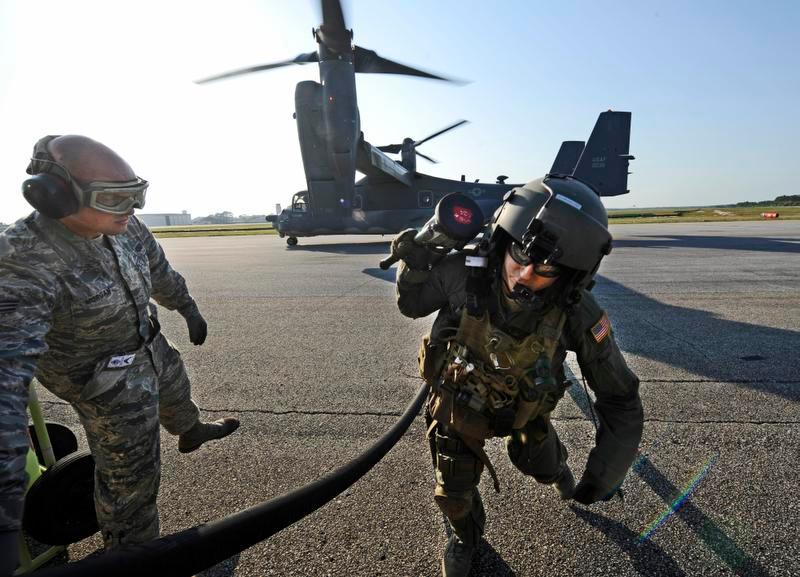
The main focus of the new fleet is the CV-22 fleet, which is an average of 3.4 years old. The Air Force has 39 Ospreys flying at a mission-capable rate of 59.3 percent. The service plans to have 50 of the tilt-rotor aircraft.
Despite a rough beginning and a lower mission-capable rate compared with the rest of the service’s helicopter fleet, the Osprey has begun to prove itself in operations, such as in December’s attempted rescue of American personnel in South Sudan. Though ambushed, the aircraft proved to be “battle-hardened,” according to one aviator on the mission.
“History is now proving that the airplane is all we thought it was going to be,” Heithold said. “When we took it into the inventory, we weren’t real sure. Is this going to be the answer? … The airplane has proven its worth on the battlefield now. It moves in vast areas that we do some of our missions at. … What we’re proving is the kind of capability we need to have in special operations.
Future needs
For future missions, AFSOC needs new airmen who can respond quickly to situations that are not predicted, in changing missions and in dangerous circumstances.
“They need to adapt and change quickly. They need to operate on the commander’s intent. … There will be a mission to do, but they will not be told a lot on how to do that,” Heithold said. “There’s not a lot of predictability on what’s going to occur.”
U.S. Special Operations Command is in the final stages of crafting a plan for how special operators will target extremism globally. The Global Campaign Plan for Special Operations Forces, directed by former SOCOM commander Adm. William McRaven, will require airmen in AFSOC to consistently deploy, train and be involved with partner nations to combat the spread of extremism, which has grown and includes new threats, such as the Islamic State.
“We’re going to have to be on our game,” Heitholdsaid.