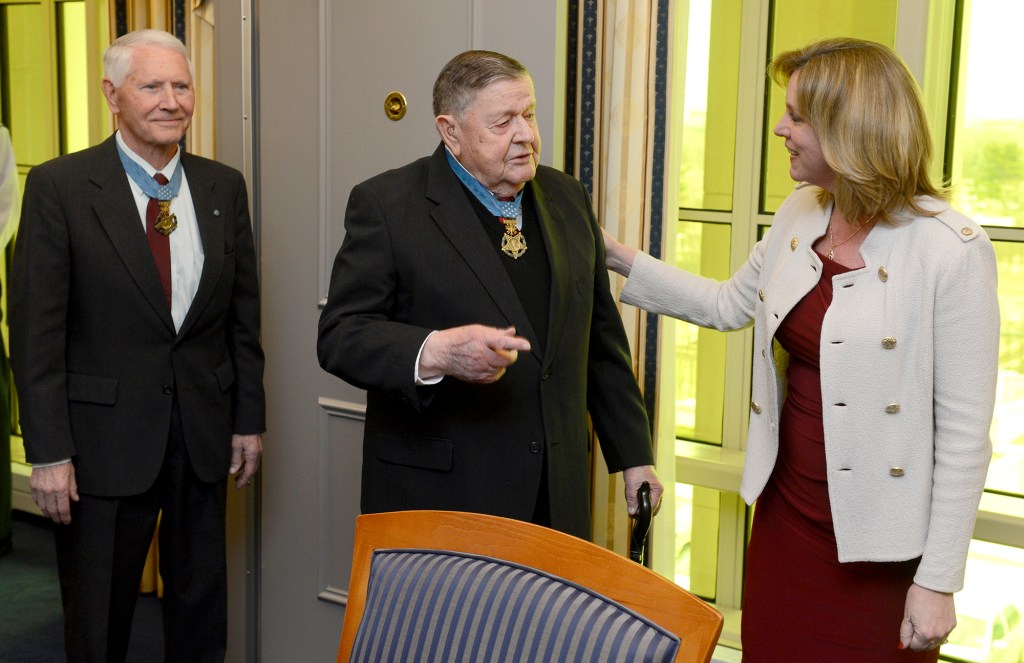
Two Vietnam-era Air Force Medal of Honor recipients visited the Pentagon on March 24 with this message for airmen: Teamwork is critical to mission success.
In observance of National Medal of Honor Day, which is March 25, Air Force senior leaders hosted a Q-and-A session with the men: retired Cols. Joe M. Jackson and Leo K. Thorsness.
“Always try to do the right thing,” Thorsness told airmen in attendance. “I can’t say that I have always done the right thing, but the faith I have in God brought me through many occasions.”
The men said trust and loyalty are the foundation for effective teamwork in peacetime and in war.
“We are honored to have our Air Force history among us today,” said Air Force Secretary Deborah Lee James. “Getting to hear these amazing airmen’s stories firsthand is something special.”
On May 12, 1968, Jackson, commander of an unarmed C-123 transport aircraft, flew from Da Nang to Kham Duc, South Vietnam, on an emergency mission. A Special Forces camp at Kham Duc had been overrun by enemy forces and three men had been left behind when others evacuated. Jackson made an assault landing on the airstrip under heavy enemy fire. Once the team was safely on board, he quickly took off under a mortar barrage and intense automatic weapons fire from the surrounding hills. After landing at Da Nang, the crew found that not a single bullet had touched their aircraft during the flight
On April 19, 1967, then-Maj. Thorsness, piloting an F-105, was flying with a strike force to suppress surface-to-air missile sites in North Vietnam. Acting with his electronic warfare officer, Thorsness detected one site as it was about to launch an attack and destroyed it with a Shrike missile. Almost immediately, another site was discovered. Thorsness flew through heavy antiaircraft fire to score direct hits on the site with cluster bombs.
On the second strike, Thorsness’ wingman was hit and the two crew members bailed out. As he circled the descending parachutes, a MIG-17 appeared. Thorsness dived but his shots missed the enemy fighter. He attacked again. Just as he pulled up to avoid a collision, he saw the fighter spin and crash.
He was low on fuel but learned that two helicopters were waiting for an escort before attempting a rescue of the downed crew. Thorsness flew back, spotting four MIG-17s as he neared the bailout area. He attacked and damaged one of the enemy aircraft. He drew the others away by diving and flying close to the ground until they gave up pursuit.
Now critically short of fuel, Thorsness advised another F-105 to fly to the nearest tanker. He then diverted to a forward base where he landed with only a 10-minute supply of fuel remaining.
Eleven days later, he was shot down over North Vietnam and held prisoner for nearly six years.