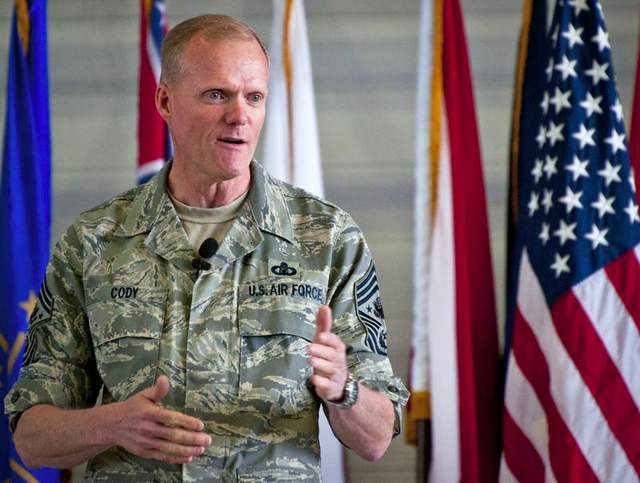
Since he became the Air Force’s top enlisted man in January 2013, Chief Master Sergeant of the Air Force James Cody has been helping lead the charge to reform how enlisted airmen are evaluated and promoted. Now the final pieces are falling into place. Cody spoke exclusively to Air Force Times at Joint Base Anacostia-Bolling in Washington, D.C., on June 12 about the new EPR system.
Q. When airmen ask you why we need this new system, what do you tell them?
A.It’s all about performance. We had to acknowledge … inflation in EPRs [and] my entire career, it’s been a dialogue. So it came to this point where we really had to decide, how are we going to build this from the ground up? Everybody expects one thing out of an airman: performance. So you better have an evaluation system that feeds a promotion system that makes that the number one priority.
Q. What’s going to be the trickiest element of this rollout?
A. Communication is always the trickiest part. What we have to do is be very open and transparent, which I think you see we are being. We’ve been open along the way, what decisions we’ve made, we’ve shared them, which ones we haven’t, we said we haven’t made it yet, we’re doing the analysis.
As we move forward, we’re not going to promote any more people than the Air Force needs to promote in any career field and across the institution as a whole. So you’re still going to have the same amount of people who are happy and who aren’t happy. Some of them will self-reflect and say that was me, but human nature tends to say, it wasn’t me, it was something about the system that wasn’t fair to me. So we’ll have to work through that.
It [will take] several years for this to really institutionalize [because] we’re still going to have the old reports influencing this [for the next three years]. It’s going to building credibility [as] people say, you know what, those really were the right people to get promoted first. If the vibe in an organization changes, that’s how credibility comes into this.
You know there’ll be naysayers. There already are. The fact is, every commander always has to be able to justify the things they do. We all have that responsibility. If we make a decision, we have to be able to answer for that decision.
Q. When you hear someone raise the concerns about a good ol’ boy club, what’s your response?
A.We are very honest and up front that there’s a level of subjectivity to this. This is a subjective evaluation based on established expectations, that relate directly to our standards. But by adding in this process where we bring the [Airman Comprehensive Assessment feedback form], the feedback in with the EPR, through the rating chain, so there is clear visibility and everybody sees it, it does help in this aspect, that everybody sees what everybody sees in the rating chain that have responsibility.
There’s never going to be a scenario where somebody isn’t going to be able to provide a valid example of that [type of favoritism]. We try to build a system that does not allow for that or makes it very difficult to do that. But the idea that I would say that would never happen, I’d just be putting my head in the sand. But I do think we have a system that, if you look at it objectively, I’m not sure how much better it could be. The transparency helps minimize that.
Q. As you go forward with this new system, will you be open to tweaking it if you find some aspects aren’t working as intended?
A.Certainly with the execution part of this, we’re constantly evaluating this. When we initially came out with the static closeout dates, we didn’t really get down to, what happens when you’re a selectee? So we went back and adjusted it to say, [the closeout date is] for those wearing the rank and for the selects.
We have red-teamed this thing a thousand times over, but our airmen will be the best red team ever. We are anticipating quite a bit of feedback as we execute this and … we will certainly make adjustments if we think we are breaking things. But the basic concept of forced distribution, stratification limitations, these are kind of a defined decision that you have to stick with for a few years.
Q. Former Chief Master Sergeant of the Air Force James Binnicker, who passed away earlier this year, helped establish the EPR system in the 1990s. How did he help you create this new system?
A.My great mentor, it was a really difficult loss for our Air Force, for our airmen, certainly personally for me. He was a really dear friend. Chief Binnicker and I [as well as the other former CMSAFs] spent a lot of time talking about this. The one thing that Chief Binnicker said to me, it came down to this forced distribution and stratification. He said, “You have to do it. If you don’t do this, don’t do anything.” Because if you don’t put these defined limitations, quotas, whatever word people want to use, you don’t do anything.
There’s probably no other organization that’s as big as ours is, that has stuck with a system that didn’t really produce the results we needed to for as long as we had. It’s the right time in our Air Force. We owe it to our airmen. We’re asking a lot of them, they’re working really hard, we have to acknowledge they’re working really hard, and we have to do something that quantifiably tells them we recognize that. It feels good to be able to take it over that hump.