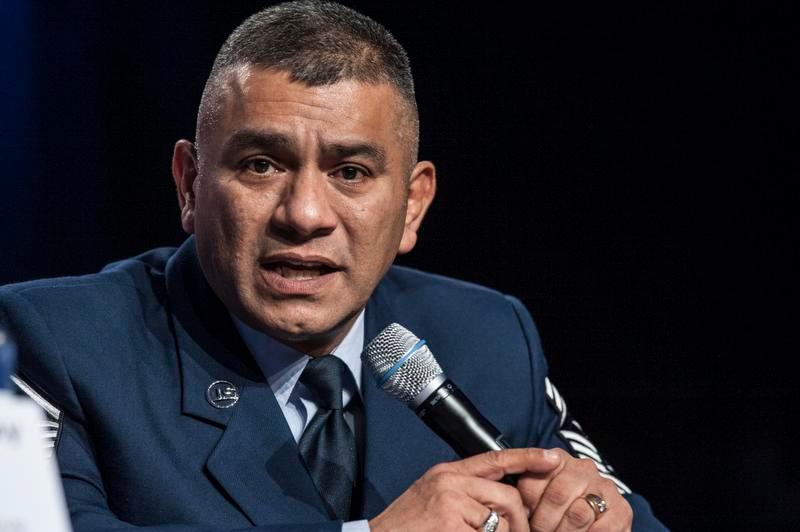
The impending overhaul of the enlisted performance system dominated the chief master sergeant forum on the opening day of the 2014 Air Force Association’s Air and Space Conference outside Washington, D.C.
The hour-long question-and-answer session with five chiefs began Monday afternoon with remarks from each of the leaders on what they consider the biggest hurdles to implementing sweeping changes to how the Air Force rates and promotes enlisted airmen. Questions from airmen in the audience about the overhaul kept on coming, suggesting that buy-in from the ranks may take the most work of all.
Many of the details of the new system aren’t yet public. But the new performance reports seek to give airmen a more honest assessment of how they are doing, contrary to the long-time system in which the majority of airmen score five out of five points. The phenomenon has come to be known as the “firewall 5.”
Chief Master Sgt. Gerardo Tapia, command chief master sergeant of Air Education and Training Command, said he regularly asks the hundreds of technical sergeants he meets at the NCO Academy if they think the current system needs to be fixed.
“All of them raise their hands,” Tapia said. “When I ask how many think the current system is inflated, all their hands stay up. When I ask how many are ready to get a [score of] 3 or 4, all the hands come down. Everybody wants it changed, but not at their expense.”
Tapia sought to ease airmen’s worries. You can receive an honest assessment of your performance and “still be in the hunt to get promoted,” he said.
Chief Master Sgt. James Hotaling, command chief master sergeant of the Air National Guard, told a similar story of more than 1,000 comments — most of them negative — going up on an Air Force Facebook page within minutes of an announcement about the new EPR.
“We are in tune to the concerns,” Hotaling said. But “the Air Force can choose to be a victim of this process or be victorious.”
For once, leaders will be forced to make difficult decisions about their airmen when it comes to evaluating their performance, said Chief Master Sgt. Harold Hutchison of Pacific Air Forces.
“Have trust and faith in your leaders that they will do the right thing,” he said.
Left unchanged over the decades, “we’ve built some pretty bad habits” into the evaluation system, Tapia said. “To convince airmen it’s the right thing to do is paramount.”