
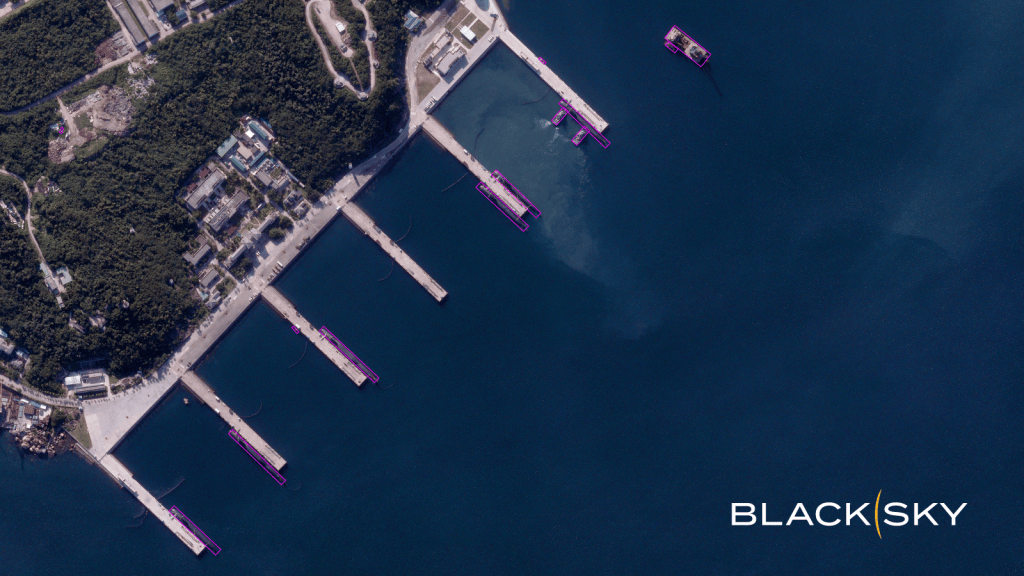

Modern warfare moves faster than ever. As conflicts erupt around the world, governments and ministries of defense recognize an immediate need for fast, reliable space-based intelligence. This urgency is forcing nations to rethink how they acquire and control space capabilities.
Real-time intelligence requires a modern space architecture
Operational urgency is now measured in minutes and hours, not days or weeks, and space-based intelligence must keep pace to remain mission-relevant.
“Tactics that are highly effective one week are obsolete just a few weeks after that. The speed of modern warfare is significantly faster than it has been in the past. And thatmeans that your space-based intelligence to also be fast.”
– BlackSky Chief Technology Officer Patrick O’Neil
Real-time imagery requires low-latency delivery, high-frequency revisit and AI-enabled automation throughout the collection pipeline, with maximized satellite uptime, prompting nations to reassess the architecture needed to operate at the speed that modern missions demand.
Space sovereignty is evolving
As satellite and launch costs have dropped, sovereign space capabilities have become more accessible.
Previously, nations needed to spend hundreds of millions of dollars to field their own satellites. Those unable to invest at that level relied on commercial providers, accepting the risk of lower priority data collections or having critical imaging requests unfulfilled during periods of heightened need.
With lower costs and increased operational urgency, nations are adopting a spectrum of sovereign options:
- Dedicated capacity on commercial constellations
- Owned satellites licensed in-country
- Owned satellites operated by a provider
- Fully sovereign systems, including national ground segments
Most effective, however, is a hybrid model that supplements sovereign systems with commercial constellations to maximize capability and maintain revisit during rapidly changing scenarios.
The role of AI
With a massive amount of geospatial intelligence available, leveraging AI is key to maximizing mission relevance in several ways.
1. Tipping and Cueing
AI determines where satellites should look by analyzing large areas, finding hidden or moving targets and constantly updating collection priorities as conditions change.
2. Exploitation
AI detects objects, analyzes changes and summarizes content automatically, eliminating the need for analysts to review every pixel. As collections scale to thousands of image scenes a day, AI quickly identifies which matter most, keeping intelligence relevant at operational speed.
3. System Diagnostics
AI automates satellite behavior and accelerates fault diagnosis, replacing the slow process of manually reviewing logs and telemetry and helping sovereign operators maintain responsiveness at scale.
These capabilities strengthen sovereign systems, helping manage satellites and imagery at the speed required in today’s operational landscape.
Sovereignty is becoming the defining requirement for modern ISR. Falling costs and rising operational speeds are leading nations toward architectures that deliver real-time intelligence, assured control and AI-enabled exploitation. These capabilities form the baseline for space systems built to operate at the speed missions demand.
Explore how BlackSky Mission Solutions delivers sovereign space-based intelligence built for operational speed, control and resilience.