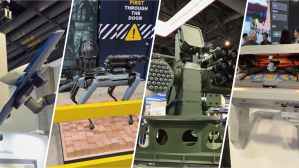
In the wake of Iranian attacks that devastated U.S. bases in the Middle East, the U.S. Air Force wants portable air-defense guns that can destroy drones and cruise missiles.
The Ground-Based, Medium-Caliber Gun Weapon System project is aiming for a weapon “that fires affordable munitions, enables defense against air and missile threats with an initial focus on subsonic cruise missiles (CM) and Unmanned Aircraft Systems (UAS) to provide persistent defense in support of United States Air Force assets,” according to the Air Force’s Request for Information published Thursday. The deadline is Oct. 9.
Iran has unleashed retaliatory strikes at U.S. military installations and civilian infrastructure across the Middle East amid bombardment by U.S. and Israeli forces.
U.S. troops were killed when an Iranian one-way attack drone evaded U.S. air defenses and struck a makeshift operations center at a civilian port in Kuwait. More troops were killed in attacks on Muwaffaq Salti Air Base in Jordan and on Prince Sultan Air Base, Saudi Arabia.
The Iranian strikes have also damaged U.S. aircraft, including five KC-135s on the ground at Prince Sultan Air Base.
The Air Force’s RFI doesn’t request a specific caliber for the new weapons system, but “medium-caliber” suggests a weapon in the 20mm to 50mm range. In August, the U.S. Army published a Sources Sought notice for a 50mm anti-drone cannon and ammunition. The Army plans to conduct a live-fire test using Northrop Grumman’s XM913 Bushmaster 50mm chain gun, with companies supplying 50mm ammunition.
The Air Force’s weapon will have 15 baseline parameters, including its probability of kill, or PK, against subsonic cruise missiles, as well as Group 1 to Group 5 UAVs, meaning small drones all the way up to very large unmanned aircraft flying above 18,000 feet.
Contractors “must carefully select the organic sensor capability and phenomenology—integrating the right mix of radar, electro-optical, infrared, or radio-frequency sensors—to ensure reliable target acquisition and tracking across varying weather conditions, environments, and countermeasure scenarios,” the Air Force emphasized.
Weapons will also be assessed for range and elevation, magazine capacity, number of crew needed and integration with other sensors and command networks. They must also be capable of stopping saturation attacks by drones and missiles.
The Air Force is also looking for a portable air defense weapon with “a lightweight, modular, and transportable footprint that can be swiftly projected into austere theater environments to meet emergent threats.”
Based on the RFI, the Air Force appears cognizant of modern air defense’s biggest challenge: air defense systems that are either much more expensive than the drones and missiles they are trying to stop, or systems that run out of ammunition before an attacker does.
The new weapon “must optimize munition performance versus munition cost and gun capability, ensuring that the interceptor’s velocity, maneuverability, and terminal effects are maximized without driving the cost-per-engagement to unsustainable levels or exceeding the physical constraints of the host platform,” the RFI said.