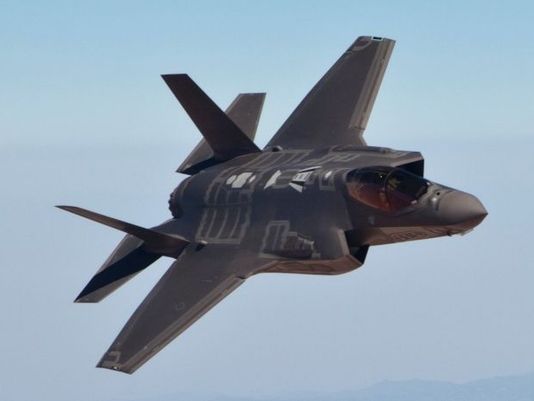
The F-35 is going to eat up so much of the Air Force’s procurement budget going forward that the service will likely have to reduce the number of Jjoint Sstrike Ffighters it buys to pay for other things, such as the Long Range Strike-Bomber, experts said on Tuesday.
As part of the Defense Department’s proposed budget for fiscal 2016, the Air Force would purchase 44 F-35s this fiscal year, 48 in fiscal 2017 and 60 each year from fiscal 2018 through 2020, budget documents show. The total procurement cost of the 1,763 F-35s is about $215 billion.
The Air Force also plans buy between 80 and 100 Long Range Strike-Bombers for up to $100 billion. The new bomber will replace the Air Force’s fleet of B-1s and B-52s.
In order to pay for the bomber, the Air Force will likely have to reduce the number of F-35s and other procurement programs, said Richard Aboulafia, an analyst for the Teal Group.
“You’ve got so many competing requirements for the Air Force’s procurement budget, and on top of that, you’re inserting $4 to $5 billion a year for LRS-B [Long Range Strike-Bomber] – or more –— , I believe it peaks at a somewhat higher number than that. T– there’s no way right now to make that all work,” Aboulafia told Air Force Times after speaking at the Mitchell Institute for Aerospace Studies.
Given the current budget situation, Aboulafia believes the Air Force has four options for the bomber.
“One: You could grow the topline [budget], which is not likely,” he said. “No. 2: You can create this national strategic priority line which comes out of somebody else’s budget – a lot of people tried that. It generally doesn’t work. Three: It can die and become a bill-payer for all for the other programs, which would be sad. Or four: The other programs have to give ground, either in terms of year-by-year procurement numbers or total procurement numbers, or both.”
Since the F-35 represents the lion’s share of other procurement programs, the Air Force’s stated goal of buying 1,763 Jjoint Sstrike Ffighters has become “highly untenable,” Aboulafia said.
Right now, the Air Force is working on its portion of the president’s fiscal 2017 budget and “is exploring all options based on world events and financial constraints,” said Air Force spokeswoman Ann Stefanek. More information about procurement programs will be available when next fiscal year’s budget is released, she said.
The Air Force may not want to reduce the number of F-35s it plans to buy, but by the mid-2020s the program will take up more than half of the service’s planned procurement dollars, and that means that unless the Defense Department budget goes up significantly, it will have to live with fewer F-35s, said Mackenzie Eaglen, a defense analyst at the American Enterprise Institute.
Meanwhile, Canada plans to withdraw from the F-35 program and Norway may follow suit, and that will increase the cost of each F-35, said Eaglen, who also spoke at the Mitchell Institute.
The Defense Department as a whole faces a funding crunch, said Jacques Gansler, former undersecretary of defense for acquisition, technology and logistics.

Retired Lt Gen David Deptula.
Photo Credit: Michael Pausic/Air Force
“It’s not just the fact that they don’t have enough money to buy some bombers but they’re also short of dollars for next-generation research and they’re short of dollars for things like cyber security,” Gansler told Air Force Times after the Tuesday’s Mitchell Institute event.
Given the current funding constraints, the Air Force needs to justify why it needs all 1,763 F-35s, he said.
“Originally, when it was going to be $35 million each, that wasn’t a problem,” he said. “But now they’re so much more expensive than even some low-cost fighters that other people have.”
But retired Lt. Gen. David Deptula, dean of the Mitchell Institute, argued that the F-35’s cost should not be confused with its value.
“Looked in the context of the value of what this airplane brings to the equation: No, we’re not spending too much on it,” Deptula said on Tuesday.
Both the F-35 and Long Range Strike-Bomber are more than merely replacements for 20th century aircraft, he said. These aircraft have the ability to seamlessly share information in ways not seen before.
“You have to think about the capabilities that modern aircraft provide,” Deptula said. “They’re not just fighters or just bombers. They can conduct a variety of different tasks and enable a completely new operating concept that has the potential for completely dislocating conventional warfighting strategies.”