The Air Force’s planned cutbacks of thousands of active-duty members have prompted the reserve components to try to capture as many of the airmen as possible to beef up their ranks and keep the training and experience “in blue.”
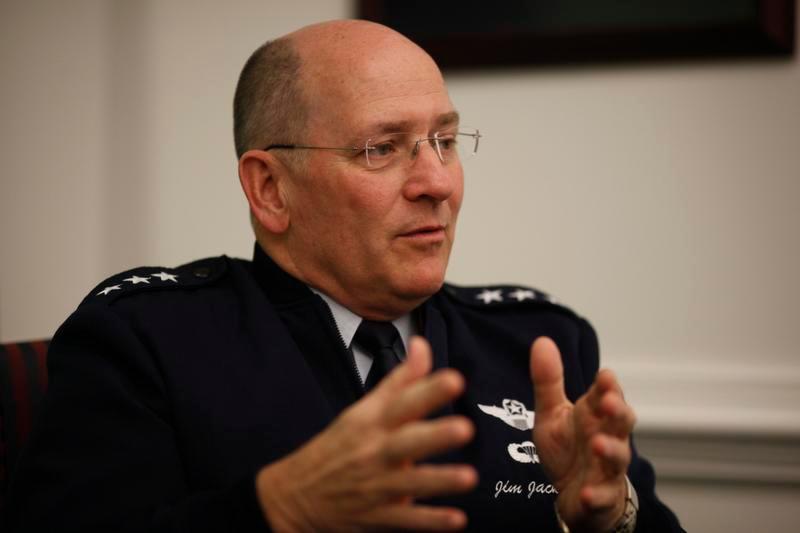
Lt. Gen. James Jackson, chief of Air Force Reserve, said his command has a two- to three-year window to reach out to active-duty members — those facing separation or deciding on future plans — and persuade them to stay in the service as reservists.
“There’s a big investment this nation has made in these airmen,” Jackson said in a Sept. 10 interview. “We are trying to capture as many of those as we can.”
The Air Force has approved 13,400 for voluntary separation and more than 6,000 for involuntary separation this year as it cuts its total active-duty contingent from 327,600 this year to 307,000 over the next five years.
This is happening as the percentage of prior service personnel in the Air Force Reserve has jumped from 48 percent four years ago to 55 percent now, and the Reserve wants to keep this figure climbing. To do so, the reserve components have multiple programs to try to capture those airmen in transition: Palace Front, for airmen who have served their whole active-dutycommitment, and Palace Chase, which allows airmen to serve the remainder of their active commitment in the Air National Guard or Air Force Reserve.
The Reserve and Guard have large bonuses, up to $20,000, for enlisted members, depending on career field. Those with critical skills command the biggest bonuses: flight engineers, airborne operations, operations intelligence, geospatial intelligence, aerospace maintenance, cyber surety, explosive ordnance disposal and contracting.
The Reserve has seen a large increase in applications for Air Reserve Technicians, full-time Reservecivilians who manage, plan and train a unit. Technicians keep their active-duty rank, and when a Reserve unit is called to active duty, the technician enters active military duty. Typically, the Reserve sees about 5,000 applications per year for these positions, but the command expects to see about 15,000 by the end of 2014, Jackson said.
The Reserve and Guard are working to reach out to active-duty pilots who have decided to join the airline industry, which has increased demand for Air Force-trained pilots and other skills. The Air Force has offered aviator retention pay of up to $225,000 to keep pilots in the service, but if pilots decide to still leave active duty, the reserve components can keep them around in a different way.
“Airline hiring is just going to increase,” Jackson said. “We’ve made a huge investment in those pilots, [combat system operators] and navigators. If we can hire those folks and retain that investment, it’s huge for the Air Force. … The longer we have them wearing the blue, the better off we are going to be.”
Growth areas
Cyber is one of the biggest growth areas for the Reserve, and one area where the Reserve has a leg up on the active duty, Jackson said.
“It’s a great fit for citizen airmen, for part-time citizen airmen, because they can bring their civilian skill set in support of the Air Force and Air Force Reserve Command.”
Active-duty airmen in the cyber field are typically trained for about two years and can then go on to find high-paying jobs in the cyber sector.
“They are going to get hired. They are going to get wooed by a company and make the choice to go be a civilian,” Jackson said. “We can capture that talent. They can participate as a reservist. They can continue to progress, get qualifications and be directly impactful on the military side.”
To keep these airmen interested as they evolve in the cyber world, the Air Force should look at the medical corps as a model, Jackson said. If the ariman has qualifications and training that has already been paid for, they should bring that into the Air Force Reserve and receive pay and rank “commensurate with that” and let them continue to work in the career field, he said.
Another growth area expected to attract airmen leaving active duty is intelligence, surveillance and reconnaissance, has because the aviators do not need to deploy. Air Force Reserve Command has 12 units, which fly the MQ-1B Predator and MQ-9 Reaper and analyze collected intelligence.