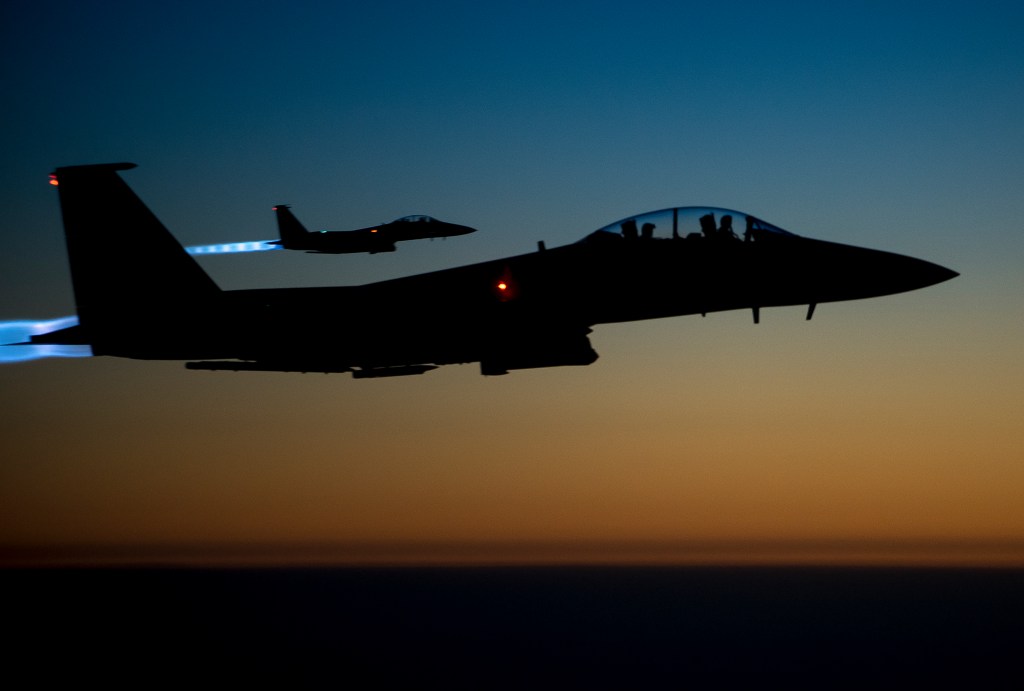
The Air Force remains busy flying surveillance and strike missions against the Islamic State group in Iraq and Syria, and those flights are affecting impacting the service’s plans for its future, top officials said.
Since Operation Inherent Resolve began in August, the Air Force has flown about 60 percent of the more than 16,000 air sorties. These include remotely piloted aircraft flights to monitor the situation, and the service’s share of the 5,886 bombs that have been dropped as of Dec. 31.
“The United States Air Force remains fully engaged in combat operations against [Islamic State] ISIL forces in Iraq and Syria,” Air Force Secretary Deborah Lee James said Jan. 15 during a State of the Air Force briefing with reporters.
While the rate of combat sorties over Iraq and Syria has been climbing since the conflict began, tThe Air Force’s role has not been to defeat the Islamic State fighters, but instead to give forces such as the Peshmerga and Iraqi Army leverage to fight, and to train more fighters to defeat the group.
“The [Defense Department] approach is not to defeat ISIS from the air,” Air Force Chief of Staff Gen. Mark Welsh said. “The intent is to inhibit ISIS, to attrite ISIS, to slow ISIS down to give a ground force the time to be trained because a ground force will be required.
“You don’t direct end states from the air,” he said. “You don’t control territory, you don’t influence people, you don’t maintain lines of control after you’ve established them. That will take a ground force.”
The This prolonged battle has started to affect have an impact on the service’s plans, and that will be apparent when the service releases its fiscal 2016 budget proposal next month, James said.
“We are constantly monitoring what is going on in the world, constantly making adjustments as a result,” she said. “The budget submission will reflect some of those changes.”
Perhaps the biggest area that needs financial help is in the mission of remotely piloted aircraft. Drones have been busy flying over Iraq and Syria, and the service is facing a shortfall of airmen to operate the aircraft.
In 2008, the Air Force flew 21 combat air patrols – available surveillance flights over a target area.
The service is up to more than 55 now, and needs to fly more to meet requests from by combatant commanders. To address the shortfall, the service is looking at additional pay to keep RPA pilots around, along with increasing the role of the Air National Guard and Air Force Reserve in drone operations.
Inherent Resolve has also pressed into service the A-10 Thunderbolt II attack jet, the same aircraft that the service sought to retire last year. As of January, the A-10 had flown 11 percent of the sorties as part of the operation, James said.