
KYIV, Ukraine — The race for a new anti-ballistic system has begun.
After decades of relying on the U.S.-made Patriot interceptor system and its hit-to-kill PAC-3 munition as the most proven air defense against ballistic missiles, three new tracks are now leveraging international cooperation and a dire global need to develop and manufacture cheaper interceptor platforms.
Some officials, meanwhile, are hoping the sense of urgency leads to the fielding of the first new prototypes by the end of 2026 — years faster than today’s Patriots can be made.
It’s an ambitious ask.
The missile defense world has long described the mechanics behind anti-ballistic defense as akin to hitting a bullet out of the sky with another bullet, multiplied in difficulty by the number of simultaneous air threats coming in — a stark reminder of the mass air raids seen today in Iran and Ukraine that stretch air defenses to the breaking point.
Today’s anti-ballistic momentum began with U.S. President Donald Trump’s seemingly off-the-cuff comment at the NATO summit in Ankara earlier this month, when he pledged to grant Ukraine permission to produce Patriot missiles for the first time.
“We’re going to give a license to you to make Patriots. That’s pretty cool. This way, you can’t complain that we’re not giving ‘em enough,” Trump said, adding that the companies that make the system’s components, primarily Lockheed Martin, had not yet been consulted on the plan.

Five days later, Ukraine and nine European countries launched a coalition in Paris to field Freyja, an entirely new anti-ballistic system centered on a Ukrainian interceptor priced at roughly one-fifth of a Patriot round.
A week after that, Lockheed Martin unveiled a cheaper, faster-to-produce Patriot missile of its own. And on Wednesday, the company announced the Pentagon had awarded it another $53.86 billion for PAC-3 production, bringing its multiyear deal up to $58.62 billion and aiming to triple production capacity by the end of 2030.
The new anti-ballistics arms race has manifested largely as a result of the munitions shortage created by the U.S.-Israeli war with Iran, during which American forces have fired at least 1,060 to 1,430 Patriots at roughly $3.9 million apiece, draining an estimated two-thirds of America’s pre-war Patriot inventory, according to a new analysis by the Center for Strategic and International Studies.
The diminished stockpile is compounded by the ongoing war in Ukraine, where ballistic missiles are the only threat Kyiv still needs help taking down and the one munition it has completely run out of.
With three new anti-ballistic tracks opened in July alone, NATO and its allies are aiming to shore up air defenses as quickly as possible.
Here is where the primary Patriot interceptor stands, and how the three new alternative pathways in the arms race stack up.
The standard: The Patriot interceptor
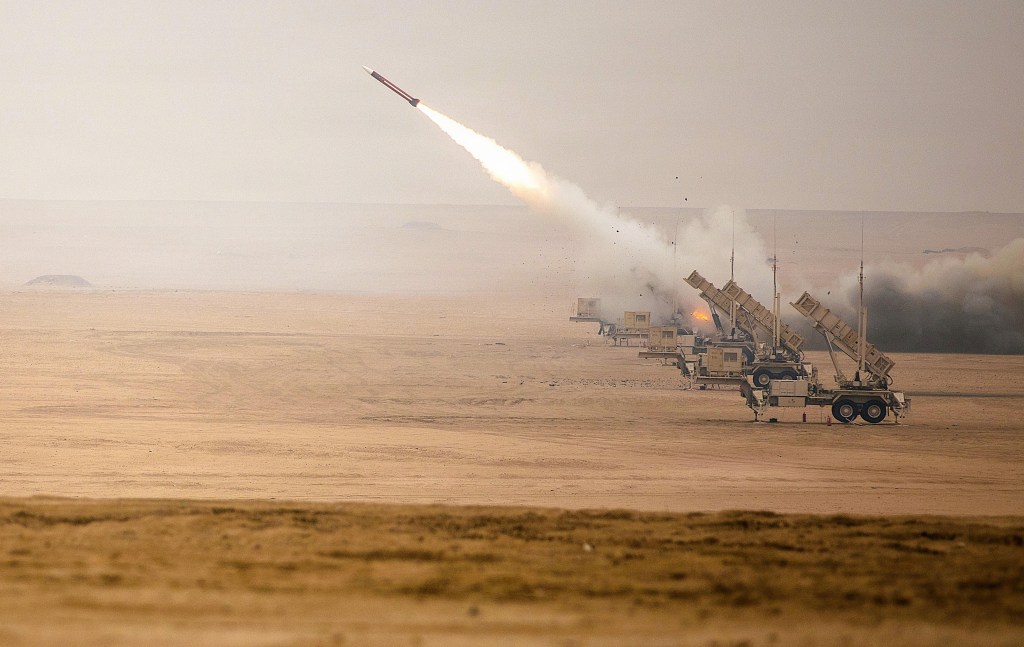
The Patriot, the U.S.-made gold standard of ground-based air defense, pairs a radar, a command post and launchers with two families of interceptor missiles, each fielded in several variants.
Lockheed Martin builds the PAC-3 MSE, the hit-to-kill round that rams ballistic missiles out of the sky, while Raytheon, which also makes the Patriot’s radars and ground systems, builds the older PAC-2 GEM-T, a round that explodes near its target and works best against aircraft and cruise missiles.
The MSE is the only Western munition that has reliably killed Russian ballistic missiles — from Iskanders to modified S-300s — in Ukrainian service. It has even downed the air-launched Kinzhal, which flies at hypersonic speeds.
That record is why the Pentagon on Wednesday awarded Lockheed a multiyear deal now worth up to $58.62 billion to triple production capacity by the end of 2030. Today, each round costs roughly $3.9 million.
“This is a once-in-a-generation moment, and we are moving with wartime urgency to deliver the Arsenal of Freedom,” Lockheed chairman and CEO Jim Taiclet said in a statement.
The grant: Ukrainian PAC-3s under US license
Trump’s pledge in Turkey would make Ukraine only the second country outside the U.S. licensed to build Patriot missiles, after Japan, which has produced them under license for decades.

Germany, the Netherlands and Spain are only now standing up a joint production line. Berlin is negotiating a license of its own and Germany’s existing GEM-T work runs through a joint venture with Raytheon rather than a national license, according to The Associated Press.
The license under discussion for Kyiv would likely cover the missiles — rather than complete batteries — and could mean final assembly from imported component kits instead of production from scratch, the AP reported.
Poland has offered to host the joint production on its territory for safety and security reasons, according to Polish news agency PAP.
“It is about securing this production, so that this production takes place in a safe location,” Polish Deputy Defense Minister Magdalena Sobkowiak-Czarnecka said in Washington on July 23.
Zelenskyy said he met with Lockheed Martin representatives while visiting the U.S. for Sen. Lindsey Graham’s funeral on July 28, posting on Telegram that “Our teams are already working on specific solutions to move to joint production as soon as possible.”
The cost of the licensed PAC-3, meanwhile, would stay the same at close $4 million per round.
Yehor Chernev, deputy chairman of the Rada’s committee on national security, defense and intelligence, estimates Ukraine needs at least 18 to 24 months to launch a first pilot production line, “followed by more time to complete the first weapons,” per The Associated Press.
Zelenskyy is pushing for even faster joint production.
“We expect that by the end of 2026, our Ukrainian team will have the technical capability to produce U.S. missiles,” he said on July 15.
The analogue: Freyja
Freyja is a full Patriot-style anti-ballistic system that includes an interceptor, launcher, radar and command-and-control network.
The system, designed by Kyiv startup Fire Point, is built around its FP-7.X interceptor missile and various capabilities supplied by European partners.
Zelenskyy called Freyja “an analogue of Patriot, but a system for more mass production and a cheaper system.”

His comments came as he formally launched the Integrated Anti-Ballistic Missile Coalition in Paris on July 13 alongside nine other countries, including Denmark, France, Germany, Italy, the Netherlands, Norway, Spain, Sweden and the United Kingdom.
The FP-7.X flew for the first time in early June and is built to kill ballistic targets at roughly 15 miles up using a high-explosive fragmentation warhead rather than the PAC-3’s hit-to-kill collision — which may come in later versions — at a target price of approximately $700,000 per interceptor, or roughly one-fifth the price of a PAC-3.
The company says it will build three interceptors a day starting in August. Zelenskyy wants the system up and running within 12 months, and the coalition is targeting its first real ballistic intercept for the end of 2027.
“We have an ambitious goal: to have an MVP ready by the first half of next year,” Davyd Aloian, deputy secretary of Ukraine’s National Security and Defense Council, told Reuters on July 27. “That is a prototype that can already demonstrate its first practical results.”
The Lockheed cost-cutter: PAC-3 ACE
Lockheed unveiled the PAC-3 Adapted Capability Effector, or ACE, at the Farnborough International Airshow on July 20.
Built on the PAC-3’s fire-control system and fully linked to the Patriot and the Integrated Battle Command System that allied air defenders already run, it is designed to counter airbreathing threats — meaning weapons that rely on oxygen for propulsion — along with cruise missiles and close- and short-range ballistic missiles, a tier below the high-end targets the MSE was built to counter.
“American and allied warfighters need a solution that is battle-tested and budget-smart, and PAC-3 ACE delivers exactly that by building on the unrivaled performance of the PAC-3 MSE,” Tim Cahill, president of Lockheed Martin Missiles and Fire Control, said in the announcement.
Lockheed says it will develop and produce the round jointly with American and European industry partners.
International manufacturing is also under consideration, with the munition’s first flight expected in early 2028.
The company advertises ACE at less than half the price of an MSE, or roughly $2 million a round, without disclosing an exact figure.