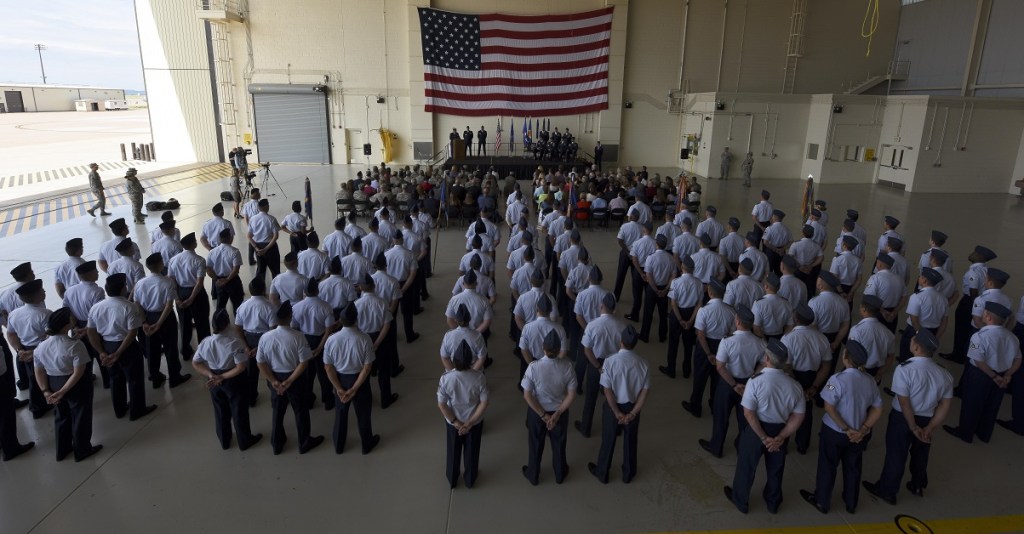
In a bid to hold on to experienced airmen with vital skills, the Air Force this year will officially change so-called “up or out” rules for senior airmen, staff sergeants and technical sergeants.
Those rules — formally known as high year of tenure — spell out when airmen in certain ranks must leave the Air Force if they are not promoted. Senior airmen, who previously would have had to leave at eight years, will now be able to stay in until 10 years.
Staff sergeants’ high year of tenure limits will be raised from 15 years to 20 years, and tech sergeants will see their time in uniform be extended from 20 to 22 years.
The policy will officially be implemented Feb. 1. Any airman who was slated to separate or retire on or after that date will have his or her tenure automatically extended to reflect the new limits.
The official change of the rules means that airmen and their commanders won’t have to jump through hoops to get a tenure extension. When the Air Force announced the changes in October, it said that airmen whose retirement or separation date was to fall before Feb. 1 would have to go through a process to request an exception to policy extending their tenure.
The tenure changes are expected to affect about 1,200 airmen each year, Chief Master Sergeant of the Air Force Kaleth Wright said in September.
The Air Force is also expected to continue work this year on its overhaul of the performance evaluation and promotion system for officers. Former Air Force personnel chief Lt. Gen. Gina Grosso, who is now retired, said in May that it could be rolled out by fiscal 2020.
Grosso said the Air Force is also working on upgrading its information technology systems to automate the performance evaluation process and put it online.
Part of this performance system overhaul could involve moving officers to a series of static close-out dates, in which all officers of the same rank would have their performance reports done at the same time. Now, officers’ reports are staggered throughout the year. A similar change was put into place for enlisted airmen in 2015.