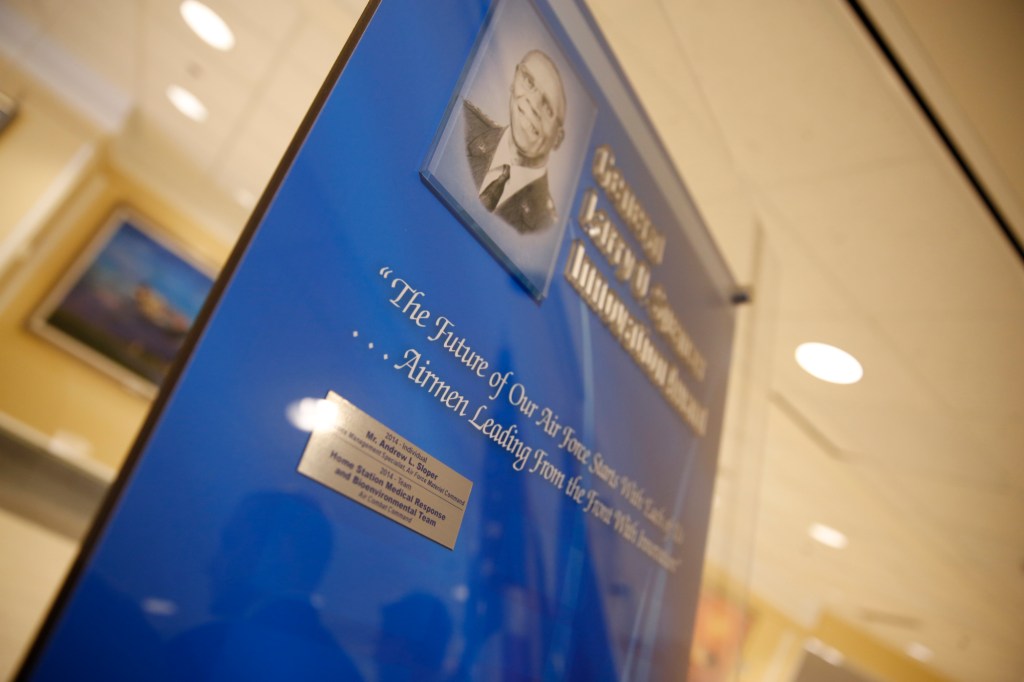
The Air Force honored a civilian and a group of airmen July 23 with the inaugural Gen. Larry O. Spencer Innovation Award.
Named for the vice chief of staff of the Air Force, the annual award will recognize airmen who create innovative ways for the service to save money and increase efficiency.
“It’s about innovation, about technology, and being the best Air Force on the planet,” Spencer said. “In a big organization like we’re in, every one of us needs to open our eyes to see what we can find and question everything.”
The awards — which will remain on display at the Pentagon — are given to an individual and to a team for ideas and actions that allowed the service to streamline operations and save taxpayers money.
Spencer said he wants to make sure “we treat Air Force money, we treat government money like it is our money. And by the way, it is our money because our taxes pay for all this around us.”
The individual award was given to Andrew Sloper, a logistics management specialist with Air Force Materiel Command.
Sloper’s work helped the military close the Palmdale, California. F-22 depot maintenance facility a year early. That not only saved the service more base operations costs, but allowed it to consolidate F-22 repair work, which has led to a faster turnaround time to get planes back in the air.
In addition, the Air Force was having an issue with a coating on F-22s chipping and getting inside engine components. Sloper was able to redesign a robot to aid in that cleaning process, Spencer said.
“This means a lot to me,” Sloper told Air Force Times. “In performing my day-to-day job this is just icing on the cake, and goes to prove that the dollar savings and everything else that we’re able to do at my level is being watched all the way up through the vice chief.”
The team recognition went to Air Combat Command’s home station medical response and bioenvironmental team led by Cols. Charles Clinton and Christopher Dun.
The group was able to identify that a piece of equipment used to detect and counter dangerous chemicals was redundant. That led to the removal of the equipment from 72 bases and installations and 36 operating units, the Pentagon said, saving $3.5 million over the lifetime of the device.
“Air Force leadership, I believe, has created a culture of innovation,” said Maj. Perry Johns, speaking for the group. “My hope is this initiative has laid a cornerstone on which the Air Force will build future success.”
Spencer noted that innovation is at the heart of the Air Force.
“The Wright Brothers started with bicycle equipment and now we have F-22s,” he said.