A former command chief at Goodfellow Air Force Base in Texas says he raised concerns that its track was longer than it should be in 2009 -- seven years before the Air Force acknowledged the track was mismeasured.
The Air Force on Oct. 6 announced that Goodfellow's outdoor running course was inspected earlier this year and found to be 85 feet longer than required. That caused 18 airmen to fail the fitness test who would otherwise have passed, the Air Force said. The Air Force also said the indoor running track at Hanscom Air Force Base in Massachusetts was 360 feet longer than required, which caused 41 airmen to wrongly fail their fitness tests. All bases have been ordered to recertify their running and walking courses by the end of October to make sure there aren't any more problems.
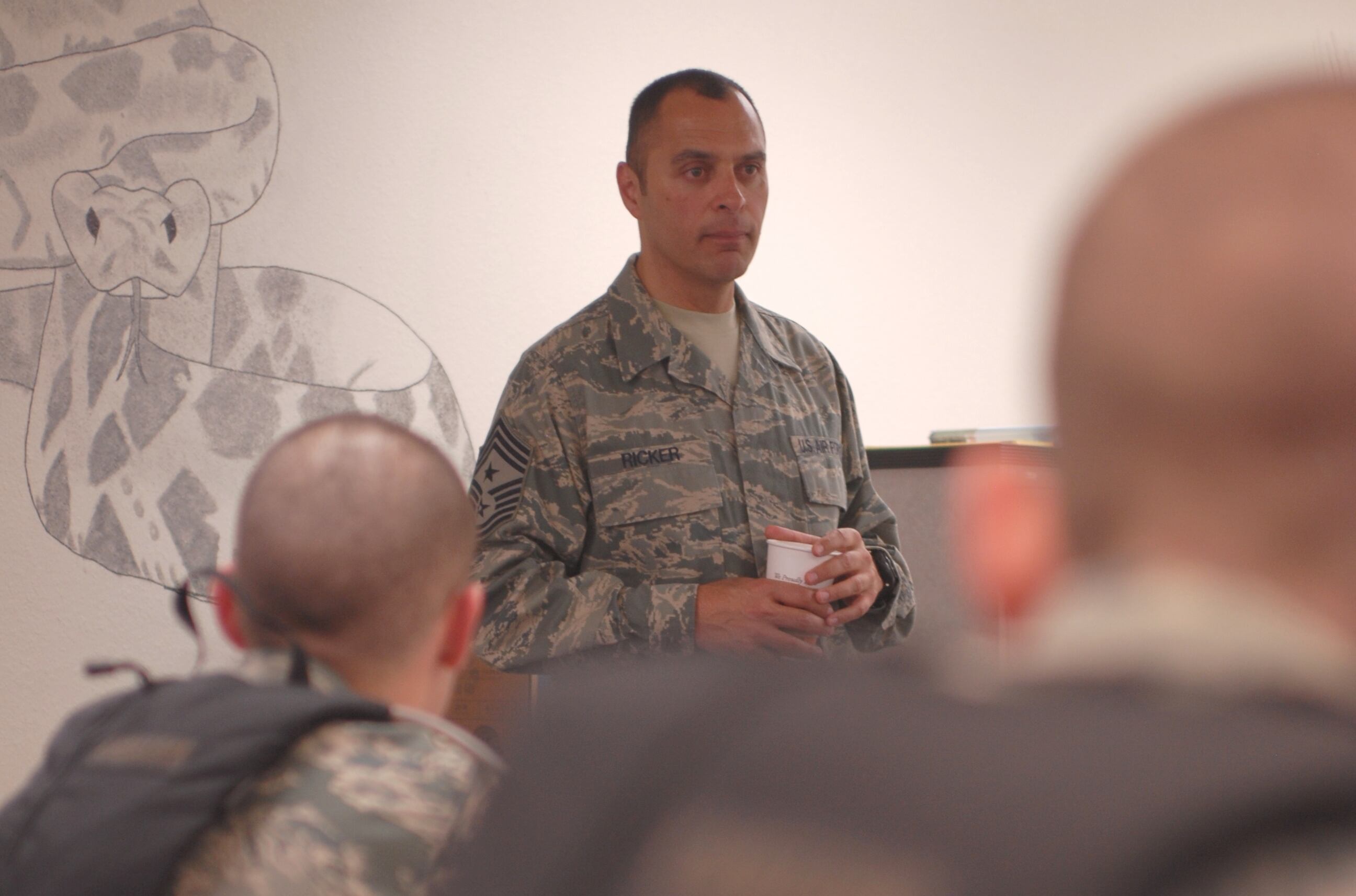
Retired Chief Master Sgt. Frederick Ricker, who was the command chief of the 17th Training Wing at Goodfellow from August 2008 to May 2010, said in an Oct. 7 interview with Air Force Times that he first suspected something was wrong with the track when he ran the quarter-mile course while wearing a GPS watch in 2009. Ricker said it took him about 20 seconds longer to run the quarter-mile track than it did when he ran elsewhere. And when his GPS watch, which he believed was accurate, told him he had already finished a quarter mile, he still had more to run.
"I remember the day like it was yesterday, because I had a GPS watch, and measured it out," Ricker said. "I knew it was too long. It was a pretty good distance -- substantial enough to fail the test, for those that were on the borderline. You have to run around that track six times, but even if its 10 feet longer on the quarter-mile, you're running 60 feet further."
Ricker said he was so concerned that the track was faulty that, with his wing commander's permission, he had an alternate straightaway track set up on a flightline and gave his airmen the option of running there for their tests. He said he got some pushback on that alternate track because it made things a little more logistically complicated, and he said he's not sure if the alternate running track was still being used.
"I was confident that the track was too long," Ricker said. "So we opened up the old abandoned flightline as a running track, for an optional testing" location.
Ricker said he reported the possible problem to Goodfellow's force support squadron, which he said re-checked the track with a measuring wheel and concluded it was fine.
"They said, 'no, it's correct, it's correct,' but I was adamant that it wasn't," Ricker said. "Is that wheel truly an accurate measurement?"
In an Oct. 13 email to Air Force Times, Goodfellow said that its Civil Engineer Squadron has no record of a measurement in 2009.
Goodfellow said that in 2010, the track was resurfaced, its lanes were widened and two more lanes were added. After that work was finished, Goodfellow said, a course measurer certified by USA Track and Field, the national governing body for track and field and long distance running, measured the track according to proper procedures.
But on March 13, 2016, Goodfellow said it conducted a periodic reassessment of the track and found the width of the track, from one inside curb to the other, measured 214 feet -- longer than the 200.6 feet measured in 2010. This meant airmen had to run an additional 85 feet during their 1.5 mile run. The start and stop points have now been adjusted to accurately reflect a 1.5 mile run, and officials have hired another Track and Field-certified course measurer to check it.
Ricker said the wheel measurement in 2009 may not have been an official measurement, but he's certain he witnessed one conducted as a result of his complaint. He wasn't sure exactly when it was held, but thinks it was in either the spring or summer of that year.
But Ricker also said he can't blame Goodfellow officials for sticking by the wheel measurement, since they thought it was accurate. And he applauded the Air Force for taking steps to try to make things right for the airmen who wrongly failed the test as a result of the mismeasurement.
Stephen Losey is the air warfare reporter for Defense News. He previously covered leadership and personnel issues at Air Force Times, and the Pentagon, special operations and air warfare at Military.com. He has traveled to the Middle East to cover U.S. Air Force operations.