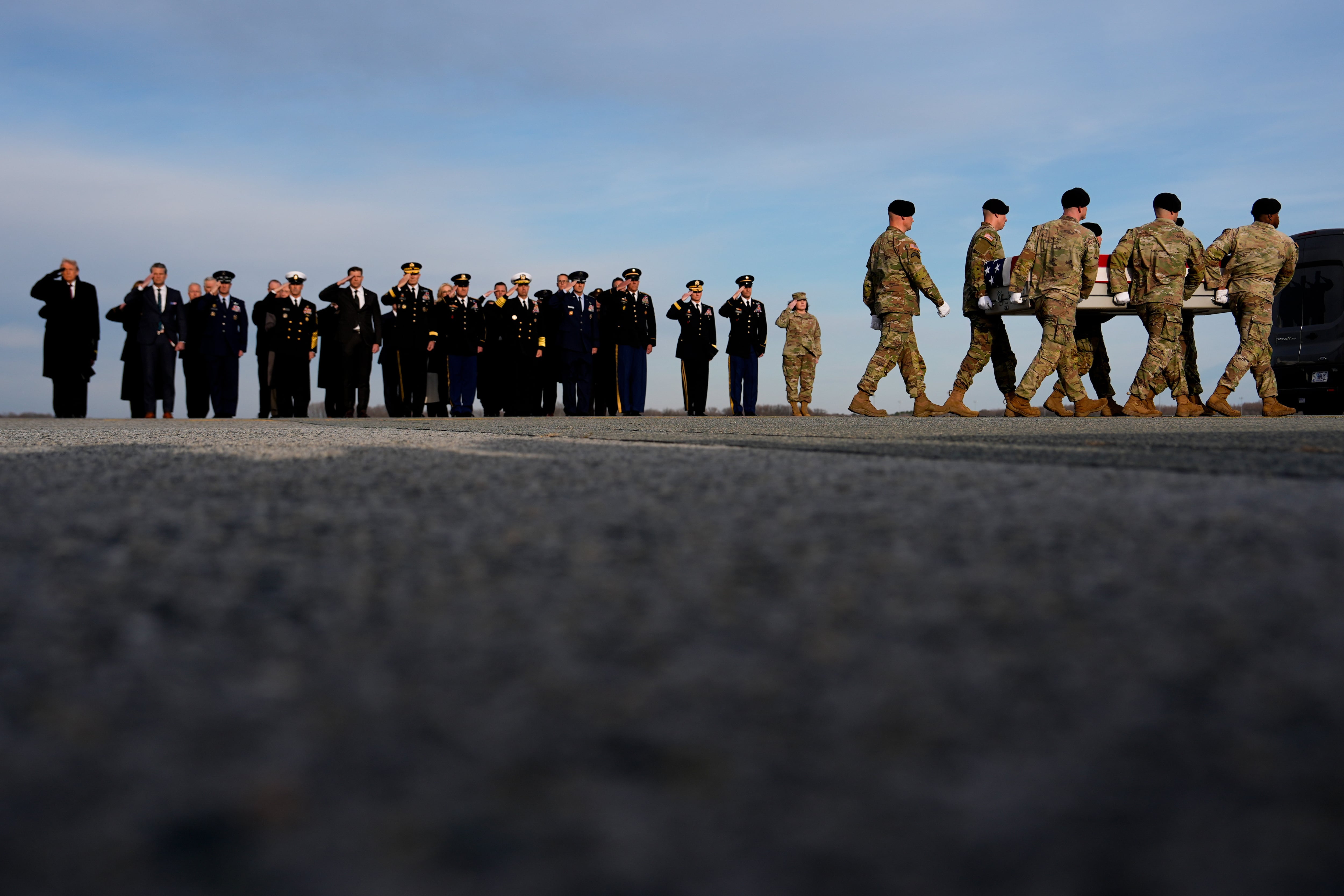
As a result, the F-16 crashed nearly eight seconds after takeoff. Both pilots and nine French service members on the ground were killed when the Greek F-16 slammed into other planes ready for takeoff.
U.S. Air Force Staff Sgt. Greggory Swarz later received France's highest military award for pulling three French aviators from the flames. Swarz was one of five airmen decorated by the French government. They also received military decorations from the Spanish government, along with a sixth airman.
The crash happened Jan. 26 at a Spanish air base in Los Llanos. A French investigation into the crash found that the Greek F-16's yaw trim had been set to maximum just before the plane took off. Investigators believe the knob controlling yaw trim may have been moved inadvertently. Stars and Stripes first reported the investigation's findings on Thursday.
The investigators noted that the pilots had been given three checklists prior to the flight. They were supposed to be stored in the plane's map case, but the pilot in command had stored his flight bag there, so there was no room for the checklists.
"Checklists are designed to be used anytime during the flight if needed," the investigation concluded. "In this regard, the possibility of a checklist temporary being placed in the FWD left cockpit console cannot be excluded."
The yaw trim knob is not easy to turn inadvertently, but investigators discovered that "a checklist positioned between the front safeguard and the knob could possibly move both roll and yaw trim knobs if moved at the correct angle," the investigation says.
F-16s are not equipped with a warning system to alert pilots of the plane if it's not trimmed correctly before takeoff, the investigation found. Moreover, the investigators could not determine whether the pilot in command checked the yaw and pitch while performing the "Before Takeoff" checklist. And personnel on the ground do not need to make sure that a plane's rudder is in the right position.
Once the Greek F-16 took off, the pilot did not have enough time to save the airplane, according to the investigation.
"The combination of low altitude, high gross weight, high right rolling movement, and minimal time available (less than two seconds), the only action to be considered by an F-16 pilot who was totally surprised by this type of problem would be ejection in a timely manner," the investigation found.
Retired Marine Col. David Gurney told Air Force Times foreign object damage in the cockpit has caused other crashes. Investigators determined that a 1983 crash of an OV-10 A Bronco was caused by a nickel that became stuck in the "clevis lug" of the stick, where it meets the floor of the aircraft.
"Tactical jet squadrons have tried to address this for years, but pilots have found ways to defeat these measures," Gurney said in an email to Air Force Times. "Some squadrons require pilots to inventory their pockets and helmet bags before entering the cockpit."
Gurney, who commanded Marine Attack Squadron 513, said that having dirt and water flying around the cockpit can be very distracting.
"On each of my post-maintenance functional check flights, I made it a point to invert the jet in level flight to confirm that nothing was left behind" he said. "Over the years, I collected pens, ear plugs, watches, and even a class ring."