If you're working on the flightline or serving downrange or doing your PT, you need to know if you are getting dangerously dehydrated before you pass out.
That's why the Air Force is developing a sensor that airmen can wear like a Band-Aid that will constantly monitor how hydrated they are.
"So instead of just guessing how hydrated you are … we can actually measure true electrolyte values and give you the biochemical signature for hydration," said Joshua Hagen of the Air Force Research Laboratory at Wright-Patterson Air Force Base, Ohio.
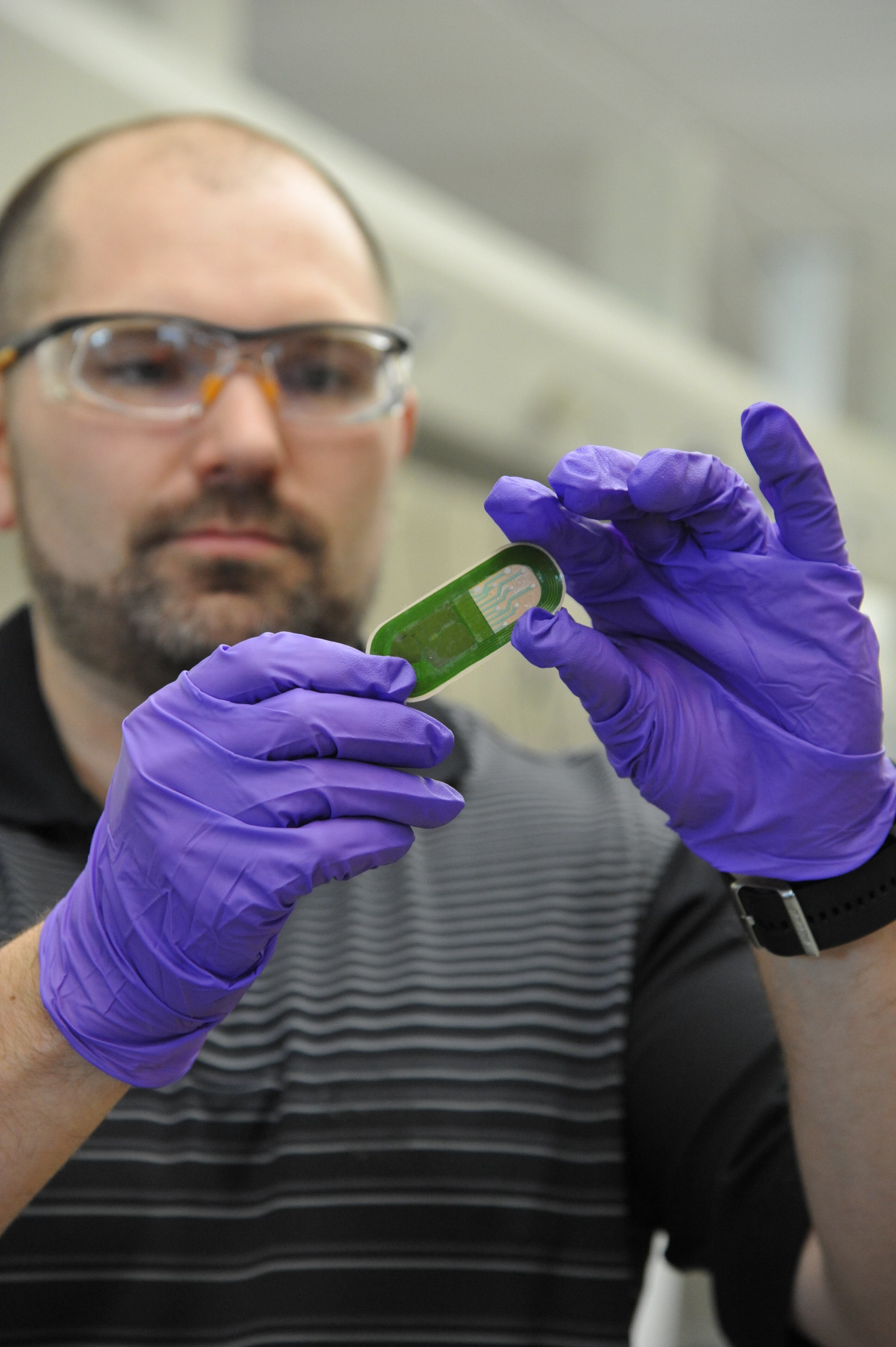
Hagen is head of the Signature Tracking for Optimized Nutrition and Training team, which recently completed human testing of a sweat sensor prototype along with the University of Cincinnati's Novel Devices Laboratory.
Right now, most airmen monitor how hydrated they are by the color of their urine, Hagen said. The darker their urine, the more water they need.
"Really, we want to prevent it from getting to a bad state, so if your urine is very, very dark, you're pretty dehydrated and you have to do some very specific things before you get a heat injury," he said. "What we want to be able to do is actually catch you way before that."
Carrying water is, of course, a good idea. "But how much do you drink, and when?," Hagen asked. "Some of the training that our airmen go through is highly physical, can last eight-plus hours, and can be in places like Texas in the middle of summer.
"Is one [water] bottle enough? What if you're pushing through training and aren't thinking about drinking your water? By the time you figure that out, it may be too late to mitigate through just hydrating and [you] may need a more invasive solution like an IV. This technology can alert the airman of their status at all times to keep them training and fighting at optimum levels," Hagen said.
Doctors can will draw blood to see if you are dehydrated, but the Air Force wanted a sensor that provided immediate results, Hagen said. As it turns out, sweat has roughly the same concentration of electrolytes and other "biomarkers" found in blood that are used to measure hydration.
"If you just think about diabetics: If they want that blood glucose value, they have to prick their finger every time they want a data point," Hagen said. "They're kind of limited by tolerance of pain. But what if we can get data points all day long — around the minute? That completely changes the way we look at these biomarker signatures."
The sweat sensor looks and feels like a Band-Aid, Hagen said. It has electronics to continually measure hydration levels. It is not yet known when airmen might be issued a finished product, and Air Force officials would not comment on its cost.
The next step will be to test different sensors on "super users" across the military services.
"They can actually use them, put them through the paces and actually give us feedback as far as usability," Hagen said. "We'll look at the data to make sure that it's accurate. So that's how we get our first level of non-lab buy-in."
There are no plans to have the sweat monitor look for traces of drugs or alcohol, Hagen said.
"It's really to provide information directly to the user so they can stay safe," he said. "We can give you information to how you can perform your best. So how can you perform your PT test the best: You need to keep your levels in this range."