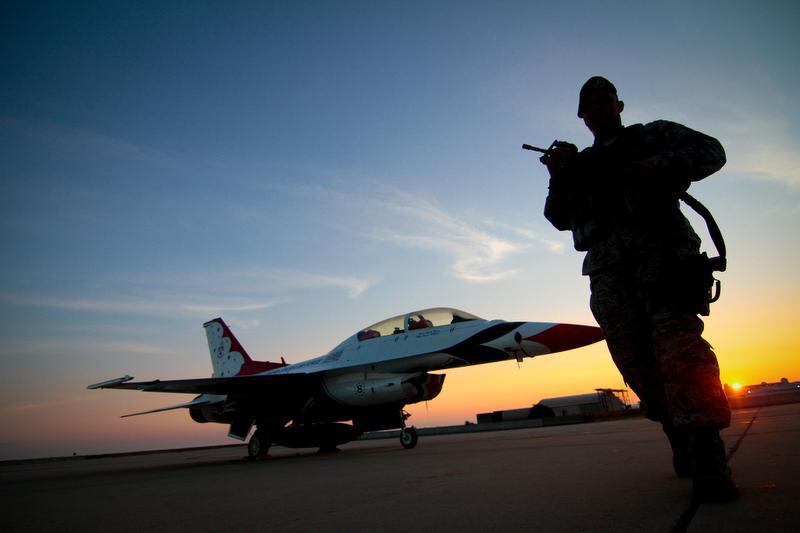
WASHINGTON – The Air Force and Lockheed Martin have reached agreement on a fix for a series of cracks impacting F-16B and D fleets around the world.
The fix involves attaching steel and aluminum straps to the front fuselage area, a service spokeswoman told Defense News.
"We expect to have a final drawing for this repair from Lockheed Martin on 5 Sep.," Susan Murphy, a spokeswoman for U.S. Air Force Material Command, wrote in an email. "Once we receive this information we will evaluate the repair to determine implementation timelines to include manufacture of the straps and verification of the repair."
The cracks in question are on the canopy sill longeron, part of the frame of the aircraft that surrounds the cockpit area of the jet. Cracks were first discovered on an F-16D model on July 31, and the service ordered inspections of the entire F-16D fleet. That resulted in 82 of the service's 157 F-16D models being grounded.
According to initial Air Force figures, the largest number of cracked F-16D models were at Luke Air Force Base, Arizona, where all 35 planes were found to have cracks.
That inspection order also applies to the F-16B and F-16D models used internationally. According to figures provided by the Teal Group, a Virginia-based consultancy, more than 150 F-16B and 400 F-16D models are operating around the world.
While the Air Force no longer operates the B model, Turkey, Israel, Belgium, the Netherlands, Pakistan, Denmark and Norway are among customers that must inspect their fleets. The Air Force could not provide data on how many international partners have been impacted by the damage.
The fact that reinforcing the cockpit area is an option is good news for the Air Force and the international partners who operate the two-seater F-16 designs. The service was also considering replacing the longeron entirely on the jets, a more invasive, and likely expensive, repair.
The service had played around with the idea of installing fasteners around the damaged areas as a temporary solution that could give the jets an extra 50-100 hours of flying time. Lockheed delivered the first such kit on August 8, which was installed on an F-16D model at Ogden Air Logistics Complex. That plane, however, will be the only one to receive the temporary repair.
"At this time, all other units have opted to wait for the permanent strap repair due to the relatively low service life of this temporary repair, risk of additional fastener hole damage by two removals and the time associated aircraft disassembly and reassembly to implement the two repairs separately," Murphy wrote.
"This option is no longer being pursued."
As a result of the cracks, the U.S. grounded more than half its F-16D fleet. That is going to have an impact on training, warned the service's top military official.
"There's going to be a short term impact because that F-16D fleet is heavily used in our training enterprise, so it will slow down training for a while until we get the solution in place," Gen. Mark Welsh, Air Force chief of staff, told Defense News.
"We'll still get the training done, but it will take longer to get done," Welsh added. "We'll have fewer pilots come out of the F-16 pipeline in the next year, and that means our replacement plan for pilots in the fleet will change and have to slow down.
"It's just going to impact everything that's down the pipeline from that initial training program as we build an F-16 pilot."
A spokesman for Lockheed Martin could not be reached at press time.
Aaron Mehta was deputy editor and senior Pentagon correspondent for Defense News, covering policy, strategy and acquisition at the highest levels of the Defense Department and its international partners.