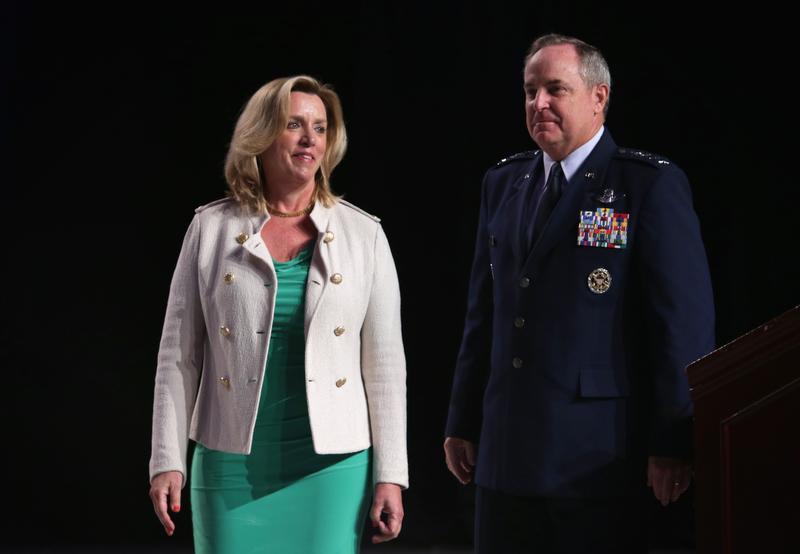
NATIONAL HARBOR, MD – The leadership of the Air Force has a clear message for Congress: Help.
“I and the chief both are calling upon Congress for some bold leadership at this time,” Air Force Secretary Deborah Lee James told reporters Tuesday. “What that means to me is, certainly first and foremost, we need a [continuing resolution] we need it promptly.”
The secretary may get her wish, as members of Congress indicated this week that a continuing resolution to fund the government could come as soon as this weekend. But that still leaves the underlying question of where the Air Force will need to cut to meet its budget goals.
The service has struggled with sequestration-related budget drawdowns, caught between the need to recapitalize major new systems and keep current fleets flying. Its FY 2016 budget request is likely to follow the path laid out in the FY 2015 request, which featured multiple weapons systems being retired.
Since sequestration hit, James and her military counterpart, Chief of Staff Gen. Mark Welsh, have been warning that if they are not allowed to retire systems such as the A-10, the Air Force will have to look into cutting readiness — something that could have negative impacts on the service’s ability to respond to crises such as the recent bombing operations in Iraq.
“If, for example, Congress says ‘No, do not retire certain aircraft in FY15,’ they must pay for that somehow,” Jame said. “My fear is they will carve it out of our readiness accounts in order to be a bill payer, in order to rearrange other funding priorities.
“So that’s the caution we keep putting forth. Do not cut it out of readiness.”
Welsh, for his part, noted that the service has not done a great job of explaining itself to Congress in the past, which has led to a lack of trust and understanding with those who control the purse strings.
“We need to make this story very clear over time,” Welsh said. “And I think that’s our problem. We have to do that. That’s not Congress’s fault, and the Air Force message has to be clear and it has to be consistent.”
Getting that message laid out clearly, through initiatives such as the service’s new 30-year strategy, will only help avoid future budget battles like the one over the fate of the A-10 close air support plane, Welsh argued.
“If you have a message as an institution, whatever the insinuation is, that is consistent over time, a planning process that is stable and a long term game plan that you are walking down that people are familiar with, comfortable with, understand that you are meeting milestones,” that all makes a difference, Welsh said.
“They number one will have more trust in where you’re going, number two probably be more confident in funding it consistently over time, and number three have a very difficult time all of a sudden having a problem with something in the plan you’ve been giving them for 10 years.”